

COLUMN: Big Emotions #1
The quality is N-R-G.

I don’t know what I’m doing on the internet, except that I very much like Juliet. She asked me to contribute to Zona Motel, and I thought if Zona Motel were a real motel I would probably be Room 17 and the bedspread would be satin and red and the things that happened inside of me (this column) would be bad motel room things. But that bored me immediately. Because I’m not the same person I was when I wrote my drug novel or my sex novel. I want more.
I thought I could be the motel’s bar instead. The bar at the Zona Motel is also red but there is a jukebox and room for dancing and no clocks and no phones and no classism but cigarette smoking and moonshine shots and spicy pizza and it is called Big Emotions.
Big Emotions was a neon sign staked in the grass at the side of the road that I saw from a car window in Kingston, New York. I remember it being pink and lowercase. I remember thinking if I owned a liquor store that’s what I would call it. But it also works for a bar. A bar that is always open and never closed, that is all capital letters the color of blood: BIG EMOTIONS.
Not that there’s anything wrong with being closed. In fact in art I prefer it. I like fragments, glimpses, dark matter. I like when my own secret imagination is allowed to do half the work or even more. Being a full-time enigma is lonely, though. While getting drunk with an intimate group of interesting people is in my top three of human activities. So let’s get emotional and talk about fiction.
Specifically, how can we, fiction writers of the twenty-first century, push the form? Because we have fallen behind the other arts, or so I propose. Music, visual art, film, theater, dance have all gone places and done things and seen other planets that the novel has yet to fathom. We’re stuck in our Victorian skirts and maybe Modernist beaded blouses and maybe-maybe post-modernist decorative glasses.
A CAVEAT as big as BIG EMOTIONS: I know there are a number of you who are doing this already, and I trust that at this very moment someone is writing something as evolutionary as Godard’s Breathless, for example, something that will make the rest of us understand suddenly: Oh, right. Jump cuts, but I’m going to go general here for the sake of argument and also hopefully inspiration.
The problem is narrative. Every time I start a novel I start it with the intention of only including in it sentences I like. The representation of this for me negatively is “She walks across the room.” I vow I will not subject my shiny-new novel to “She/I/you/he/they/we walk(s) across the room (‘It walks across the room’ could be interesting, it’s true),” but then I always do. Because at some point the story will need it. Because novels of pure style without content tend to be both boring and decadent.
There’s not a lot I dislike more in the writing world than the American middlebrow notion that what all novels are for is to tell ourselves stories in order to live, apologies, Joan Didion. I want to blow that up with a bomb but—there is a part of that, like in most bourgeois systems, that is necessary. You cannot look at every page of a novel at once like a painting. In a novel there are no people or streets or buildings you’ve never seen before like in a movie because your brain, given only words, can only imagine what it has known. Music is math like the universe is, so it is only natural that we can surrender to it so easily and ecstatically: it’s made out of the same stuff as us. Poetry has managed to free itself from time in a way the novel can’t quite because the way a novel succeeds, gains meaning, is by accretion. You do need this to lead to this to lead to this (a story, if you will) to make a novel hit.
That does not mean, however, that we are limited to what worked for Dickens or Hemingway or Pynchon. We must, as those writers did, look at the world around us. Look: right now the desire for complexly plotted epics of varying realism is largely satisfied by longform TV. Right now the desire for stylish iceberg slices of life is largely satisfied by film. Right now the desire for self-referencing mashups is largely satisfied by the hellscape of shortform video, sorry, TikTok. What can the literary novel offer to the world right now beyond pretty sentences of interiority? (And I’m writing this before A.I. has killed most of us and put the survivors in human zoos for the sentimental, petting pleasure of the other robots.)
I don’t know the answer. Instead of the answer I’d like to offer some qualities we might explore. Qualities that reflect the world around us. One thing about the world around us is that it’s moving fast. And what is needed to move fast is energy.
There’s been an infectious monotone going around literature, and I’m not saying I have not partaken. This detached, defeated, blasé gray can seem sophisticated but it’s like what country people imagine city people to be like: a little bit dead inside. Conversely, I feel a little bit dead in the country—everything is so seamless, like you can go into any CVS and take anything right off the shelf without searching through all the aisles for the one person with the key to the toothpaste. But this is the same flattening. I know from growing up in a small town in Appalachia that the placidity of trees is a lie. Wherever there is poverty there is also sad drama.
Energy should feel like a kick in the ass and kicks in the ass can take different forms. Technically, cutting to a new line helps produce energy, brevity helps produce energy, structure play helps, not deploying all adjectives ever to describe more and more minutely something that with each detail the reader will find harder and harder to see helps a lot. Emotionally, emotions help produce energy. Retrospective melancholy is not the only feeling. For example, where is the MOTHERFUCKING RAGE? There’s also humor. Real people are funny and characters should be too. But I don’t want to prescriptively pin something down that has to burn freely.
Rather than rules, how about some current currents of energy liked and noticed by me idiosyncratically? In Andrea Arnold’s film Bird (2024) a former teen dad and his two teen kids live in an apartment decorated with graffiti and one of the subplots is trying to get a toad to slime DMT by scaring it with committed off-key singing to square British pop songs. There are two cats at my corner bodega and they both wear askew, sparkly pink bowties. An Amtrak announcement: “Please do not come to the café car without shoes. Next station stop is Yonkers. Yonkers, coming up.” My neon red nails as I type this very sentence. Then there are current currents noticed but not liked by me like the wiry meth chutzpah that overtook 14th Street between First and A from the pandemic until three people got stabbed, one fatally, in front of Trader Joe’s some months ago. There were assorted goods for sale on blankets, seemingly the contents of Amazon packages stolen from the lobbies of nearby buildings, but it was too much energy, also known as chaos.
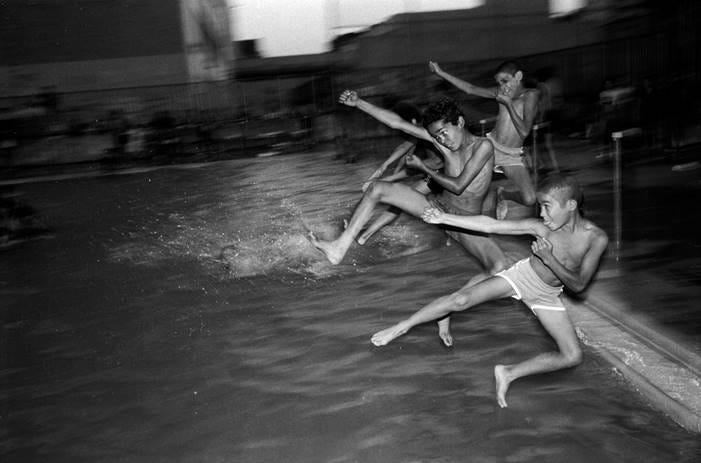
And some not-so-current currents: All the circling men jumping onto the table where Maya Plisetskaya is dancing in Maurice Béjart’s Boléro; when the drums first come in on “Smells Like Teen Spirit;” what happens after Billy, carrying two watermelons, busts open the double doors with his back in Dirty Dancing; and every discotheque second, even the slow-motion ones, of Mark Leckey’s Fiorucci Made Me Hardcore. This photograph (from Bronx Boys, Stephen Shames):
These three sentences from these three energetic books: “Rose Stanley was famous for sex.” (Muriel Spark, The Prime of Miss Jean Brodie) “‘It’s true, men are a collective hallucination of women.’” (Joy Williams, Taking Care) “I had two doubles and immediately it was as if I’d been dead forever, and was now finally awake.” (Denis Johnson, Jesus’ Son)
A morose teenager on the bus to an away game with her JV cheerleading skirt folded over twice at the waist, listening to the first disc of Mellon Collie and the Infinite Sadness on her Walkman with foam headphones and just as the plaintive instrumental intro switched to the huge romantic grandeur of “Tonight, Tonight” the switchbacks opened up and so did the obscuring trees and she thought suddenly with the swelling energy, there is also the rest of the world.
Remember that? Or was that just me?
I would like to feel that feeling again when reading one of your books. Next month: Mystery. Is it a night train? Is it a perfume that smells like the burning pages of Kafka if Max Brod had gone ahead and done it? Come back and let’s see.
Loved this. I went to restack with the part about poetry and time, and then accidentally wrote "poetry is free from tmi" which is decidedly not true.
this rules so hard