

DISPATCH: Berlin Spoken Word
"In a literary scene that, much as I love it, feels more and more infiltrated by people interested in looking like a writer rather than in writing itself, this community feels singular and crucial."


A few months ago, in a state of productive procrastination, I abandoned the review I was supposed to be working on to write a thirteen-thousand-word “essay” (?) detailing the solo trips I went on in 2025. There were six of them. At the end, I provided a list of things I had learned on my travels, among which was: you never know where you’ll meet someone who has lived in Berlin.
Most relevant to that revelation: the girl who told me about Berlin Spoken Word. I met her in North Dakota’s only remaining strip club. This was July 2025. I was not visiting the club; I was working there, but it’s not really like that. It was my sister who worked there for real. I was just joining for a week to visit her and make some money I could spend on a trip to Berlin I was taking myself on the following month. I’d planned the trip because I’d bought a ticket to a concert in Hamburg (and also felt the need to reclaim the city of Berlin for unrelated reasons), and then had realized I was by no means going to have the money to actually get myself there and have anywhere to sleep or anything to eat. So there I was in Fargo carrying out what I’d like to say was plan D or E but in reality was more like plan B or maybe even A.5. (I made ten grand. So successful plan.)
When I wasn’t bruising my knees doing the only two tricks my twig arms could manage on the pole or telling men in VIP they were “so silly” for asking me to marry them, “because I just met you!,” I sat at the bar and talked to the other girls. I did not ask why this particular girl, who was also a writer, had left Berlin and moved to Fargo. I was just glad to have found her.
Some people will tell you that Berlin has no real literary scene. But from everyone I have met who claims a space in that scene, it does, in fact, exist. It just isn’t especially visible; you won’t stumble upon it the way you might in New York, where events are more widely promoted. Someone has to invite you in, or at least tell you where to go.
Berlin Spoken Word was where to go, and this girl was my unlikely in. There are other open mics in Berlin, but that’s the original. The open mic, which is primarily for poetry, is held every Thursday evening. Their Instagram lists themes for each week, few of which I have ever remembered.
I added the open mic to my perplexing vacation itinerary (solo traveling gave me the freedom to alternate odd literary events, 10-hour stints at techno clubs, attempts to track down the magazine editor who ghosted me, a tattoo appointment, and lunch dates with every friend of a friend I could find without worrying that something might not be my travel companion’s vibe). The BSW Instagram told me to come at 19:00 if I wanted to sign up to read but 19:30 if I just wanted to listen to the readings. I confirmed several times that this meant 7:00.
August 7, 2025, Tristeza bar, Neukölln
I had no intention of reading at the open mic. I would sit and listen and judge. My expectations were low. My stereotypical assumption of an open mic was that the people wouldn’t be very good.
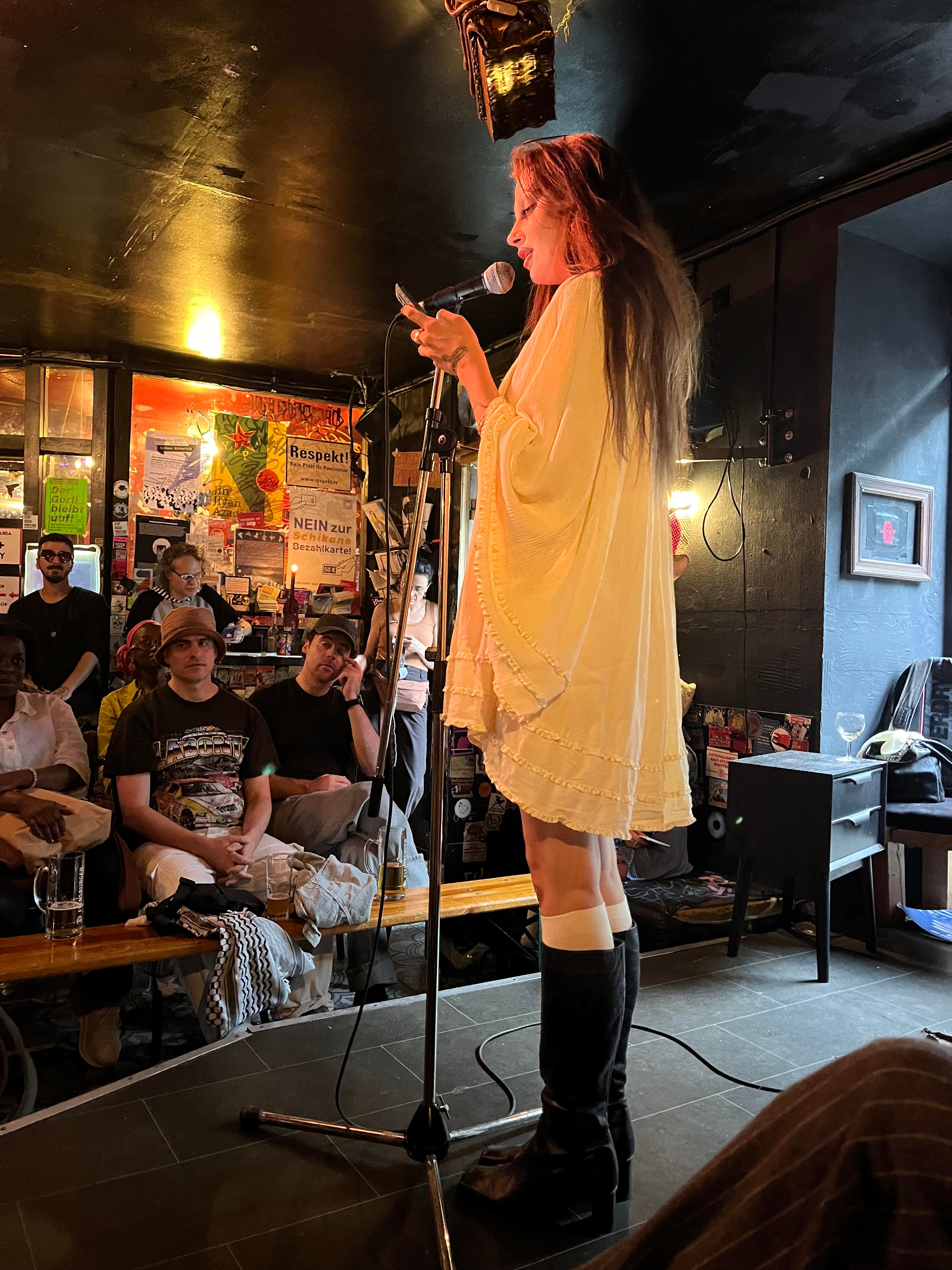
My primary concern when I got to Tristeza, a queer feminist bar, shortly before 7:30, and donated 10€ cash to a slim man in glasses at the door, was finding an outlet to plug in my adapter-charger-contraption and put my phone on life support. (I did not have a portable charger yet; you can assume at any given point on this trip that my battery was below 10%.) I sat in a row by myself near the back, next to a wall with an outlet, and spoke to no one. There was a girl in an ethereal white dress sitting in the bay window above the stage, smoking a cigarette. I watched her and wished I were that cool, or that I knew who she was.
The person who had been collecting donations at the door, who I would months later learn ran another Berlin open mic, as well as the poetry magazine Florets, introduced the open mic. There were, he said, fewer people there than usual, so they would only be doing two “halves” instead of three. There was still room on the list, he said, for anyone who wanted to sign up to read. I would not be taking him up on that. Then he laid out some ground rules. No apologizing for your work. Snap after readings like the pretentious pricks he knew we were. He also told us not to take any photos or videos, unless the writer had specifically asked us to, which I should have expected in Berlin. Just like in the clubs, no one was there to prove to the outside world that they had been there or to encourage anyone outside to come in. They were there because they wanted the experience itself.
It has been nearly a year since that night, so I don’t remember everything I heard. I remember one poem that I don’t think started out about astronomy but got there, or else it was about astronomy from the beginning but was only so emotional by the end. I often mention Dorianne Laux’s “Facts About the Moon” as one of my favorite poems, so you can imagine this was twisting my emotions exactly how the writer intended. And I remember when the girl from the windowsill got up to read. She read partly in English and partly in Russian. I was thrilled to find that her work was beautiful.
Each reader systematically eradicated my assumption that what I heard would be subpar. When attending BSW since, on nights with three halves and more readers, there are some I like more than others, but on this first night, I was in awe of everyone. I maintain that everyone who read that night was incredible.
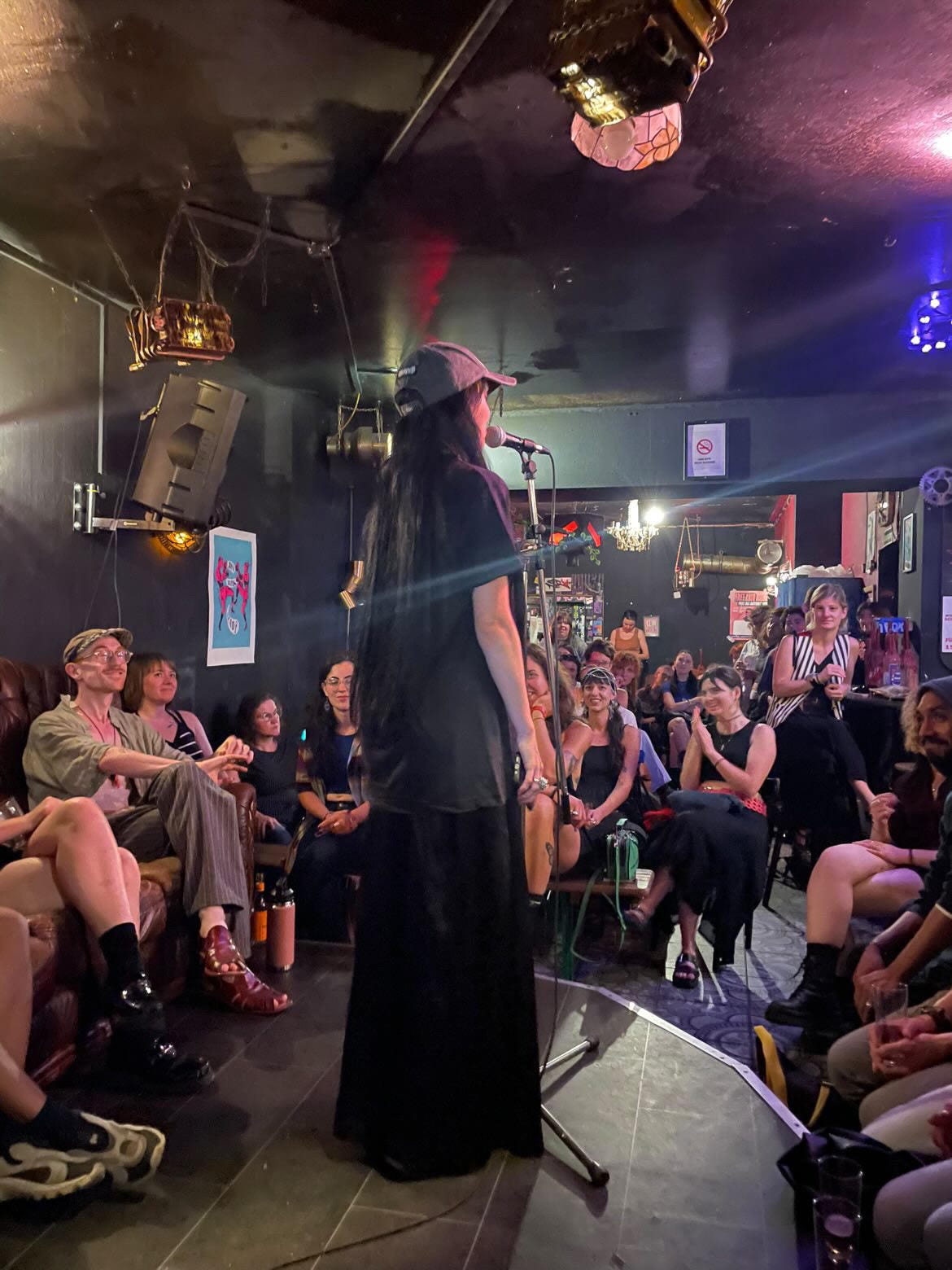
I listened to the readers, but my eyes were mostly on the crowd. I have been in many groups of writers, and none have felt as genuinely supportive as Berlin Spoken Word. I tried to determine why. The stage was curved, so the audience formed rows like ripples around it, all facing the reader. This might sound obvious, but the first time I tried going to an open mic in New York, people sat at tables facing each other while readers read—the bar had not been rearranged to benefit the reading. At readings since, I’ve experienced this often. Even if everyone is paying attention, the feeling like everyone’s focus is directed at the reader, like the audience is literally supporting them, doesn’t happen unless everyone has structured themselves as a unified crowd with writer as lynchpin.
I knew these writers felt safe in this community because of what they were willing to share. Vulnerability feels like showing someone an open wound while unsure if they will dress it or scrub it with salt, and many poems I heard that night were vulnerable in a way I have not often experienced, a way I fear many writers are afraid to be in a literary landscape that recently has favored emotionless, “cool” characters over those with anything real to feel or say. The poets here read work that identified them as humans with emotions, not just Poets with Swag. As I watched and listened, I started wanting to read up there, too. I opened Google Docs on my phone and tried to find anything that was both fit to be seen and resembled poetry. I found what could be considered a prose poem, buried in what was supposed to be revision work for my college thesis, about the fake mental illnesses I fantasized about being diagnosed with. Maybe that.
After the first half, the host told everyone to stand up. We were playing a game called “Rooftops or Flats.” He tossed a large wooden baton that was flat on one side and pointed on the other, as if it were a coin toss. Before it was tossed, everyone either held their arms in an A above their head or flat on top of each other. Up for rooftops, down for flats. If it landed on the side you chose, you stayed standing. Last person standing won a free drink. Someone told me, during my most recent return to BSW, that it is objectively a better bet to choose rooftops because the thing they toss is not fair — there are technically two, smaller sides that comprise the rooftop and only one, longer one that makes the flat. Thinking about it now, I think this actually makes flats more probable, but I am not, as I must keep reminding people, a physicist.
I don’t know what marks me most garishly and obviously as an American when I am in another country, but in Germany, near the top of the list was probably that I don’t smoke. I still went outside after the first half because the support from the writers had inspired me into a confidence I rarely felt. At the time, I was still escaping the assumption that anyone I thought worth introducing myself to would think me unworthy of their attention. Introducing yourself to someone at any sort of poetry reading is easy, though, because you have an automatic in: I liked what you read.
The girl from the windowsill was sitting on a bench with several other people. I told her I liked what she’d read. I was glad it wasn’t a lie. She invited me to sit with her and share the glass of wine she’d taken outside. Her name was Xolo. I don’t remember a thing we talked about. At the end of the break, she said she wasn’t staying for the second half but invited me to get croissants before I left for my concert in Hamburg.
I would be staying for the second half. I found the host by the door and asked if I could still sign up. He said yes, asked my name, asked if it was my first time reading there. I said yes. It didn’t matter if this wasn’t the best piece I’d ever written. I knew these people wouldn’t judge me for it, even if they didn’t like it. And I had a weird compulsion that I didn’t often feel in groups of strangers to make myself known to them. I wanted to prove that I, too, could be part of this community.
Back inside, I abandoned my chair in the back for a window sill on stage next to someone else who told me their name was Nox and that they helped to run BSW. I didn’t know at the time, but I was talking to someone deeply involved in multiple Berlin open mics and a multitude of literary events. I told them I was reading in this half. I think I may have been the first reader. I asked Nox to take a picture of me reading, perhaps once again marking myself as American.
Maybe the crowd liked me because of the introduction I gave: I learned about Berlin Spoken Word from a girl who used to come here who I met at a strip club in North Dakota while working to make money to afford this trip. I wasn’t planning to read, but I felt so inspired by everyone else that I wanted to. This is not on theme at all and only sort of a poem, but—
I did not expect to be so well-received, even after seeing it happen to everyone else. When I sat back down, Nox leaned over to me and said that was amazing. Perhaps an overstatement, but I’d take it.
I had not been to enough literary events at this point to know that you need to stick around after the event itself is over, readings done. I talked to Nox a bit more on the window sill, tried to give New York City recommendations to a woman whose friend was struggling there, despite having lived in the city not yet a year myself, and helped put away chairs. Then I walked away toward the river alone, past the people still talking outside, not yet ready to include myself but still feeling euphoric.
October 23, 2025
I left for Berlin, again, filled with resentment for Norse Atlantic Airways, who had given me travel credit after overbooking my return flight in August, then turned out to be a seasonal airline after I planned a whole two-week trip for October. On the plane, I realized I had not written a completed poem since the one I read at BSW in August. I took advantage of the seven hours I was trapped in the air with nothing to do and unable to sleep, despite once again getting a row to myself (is no one else going to Berlin?) to write one. It was about a personality quiz I took in college that told me, of all the zoo enclosures, I belonged in a terrarium. I think about that result every day, and it has rung truer with each new development in my life. Maybe one day I’ll try to get this poem published and you can read it and see what I mean.
My flight landed in Berlin at 4pm, and BSW was at 7pm, so I thought I’d have a leisurely train ride from the airport to my hostel, then head over to the open mic early. I have now twice made this mistake, but October was the first time, so I’ll give myself some grace.
I did not get checked into what ended up being the worst hostel I have ever stayed in—thank god I could stay with a friend after that night; fuck you 36 Rooms Kruezberg; never book a hostel rated 5/10—until after 7. People don’t always understand when I say I want a giant purse so I can stop traveling with a suitcase, but I should be able to go directly from the airport to whatever event I was delusional enough to think I’d make it to without babysitting my luggage.
I decided to go to the open mic anyway. I’d be late, but I could still hear the other readers and say hi to anyone I recognized. It was at a different location this time—a massive beer garden down a mostly unlit street. It had been raining, so no one was outside, and I was late, so no one else was arriving ahead of me who I could have followed in. The place appeared deserted. Where was the open mic? I wandered around outside but didn’t want to look suspicious or oblivious to the zero people watching. There was a wooden sort of walled-off area on one side of the garden, and as I walked past, I heard sounds of life from inside. I’d found it.
I walked through the door and down a little hall, wondering why it was so warm in there, and found myself in a nude bathhouse. That was not the open mic. I went back to my vile hostel after that, scared of ending up anywhere else I wasn’t trying to be. When I’ve told this story to people at BSW, several have thought having the open mic in a bathhouse is a fantastic idea.
October 30, 2025, Biergarten Jockel, Kreuzberg
The first person I saw when I returned to the beer garden was Xolo. She was smoking at a table outside. She saw me and did a double take.
Hey.
It is easier to talk to some people the first time, I have realized, than the second. Months had passed, and there was some assumption that we knew each other well enough to ask how have you been? But we certainly did not know enough about each other’s lives to be able to meaningfully answer that question. I followed Xolo to an inside I hadn’t seen the previous week, and to the bar. Then we sat on a couch near the stage, this time each sipping our own white wine. The venue was massive compared to Tristeza. You could probably have seated two hundred people comfortably, and the stage was a real, full sized stage with a curtain, several feet off the ground. I had signed up to read in the second half, and I was already getting nervous, which doesn’t usually happen to me when I read—I had all the public speaking anxiety hammered out of me by my high school writing teacher who told me to “panic in advance” and let me publicly read the self-insert unrequited love stories I was writing at the time. However over-dramatic you’re imagining these could have been, I assure you they were worse. (She is also the teacher who told me I would burn myself out by 25. TBD on that one, I guess.)
So this is why I keep going back to Berlin, for those who keep asking: they love me there, and I meet someone new every time who I then want to go back to see. I don’t know if the people at BSW actually love my work or if how much they seem to like me is a result of the fact that 70% of my Berlin travel prep regards what I’ll be wearing.
I also felt respected as a writer by BSW in ways I wouldn’t have noticed in August. In the intervening months, I’d tried to go to an NYC open mic and found that if you wanted to read, you had to pay. I reiterated this to the friend I was with, affronted: Only the readers are required to pay. You have to pay to read.
I did not read there.
In October, Nox sat at the door, asking for donations specifically from those not reading that night. It’s a small thing, maybe, but it shows that the community views the writers’ work as something of value, rather than something of a burden they must be able to afford to force on an audience. If the readers pay, that places them automatically in a position inferior to the audience.
Anyway, my terrarium poem got me swept into long-winded conversations with several different people after the third half (there are usually three halves at BSW events; the hosts never claimed to be mathematicians). I talked to a woman named Fulya about writing and Berlin and found out she was going to a concert I’d been considering getting tickets for the following May. When I found out she was going, I bought the tickets immediately. We could go together. Then I talked to Lechiek (he writes and reads under various different names). He was from Brooklyn and said he was planning to move back. He asked about my coat, an imposing black piece with white panels sewn into slits around the sides. I told him my designer friend had made it for this trip—true. One of one? Yes.
The fourth half, as they apparently call hanging around after the open mic is over, took me back to Tristeza with a group of writers, mostly American. They invited me to a Halloween party in an illegal anarchist bar they all frequented the following night, and I added that to my itinerary, having made no other plans.
May 7, 2026
Once again, I hoped to go to the open mic twice on this trip. Once again, I was arriving fueled by rage at one Norse Atlantic Airways, who had gotten rid of most of their direct flights, including the one to Berlin. Because I could only use travel credit on a direct flight, I’d flown into London the previous day, hung out with a friend, convinced myself to sleep instead of seeing what London got up to on a Wednesday night, and landed in Berlin at four in the afternoon. I once again thought this would be plenty of time to get me to BSW.
I did not check into my hostel until 7:30. The trains are mostly to blame. This gave me another week to consider if I wanted to finish revising a poem tentatively titled “Failed Defense of Self-Destruction” or read part of a short story the following week.
May 14, 2026, Ä Bar, Neukölln
I did not manage to get my ramblings on masochism into a state of eloquence in time, so I went to BSW with an excerpt of a short story to read. It was once again in a different location, which I now assume is par for the course. The strange thing about returning to a group of people every few months is that I recognized many of them, but none of them seemingly recognized me. I sat at a table alone and texted Lechiek, who had told me he was coming that night. I told him I was feeling strange. I couldn’t decide if I should approach people and tell them Hi. You should recognize me. The other friend I’d hoped to see there, a girl I’d met dressed as Kim Possible at the Halloween party in October, wasn’t sure she was up for going out. We weren’t close enough for me to unleash my manipulation tactics on her.
Lechiek finally showed up, yelling “Brooklyn!” at me to announce his presence. I asked if he wanted a drink, but he was on some strange medication that he did not trust to mix with alcohol. I asked for a vodka mate, and the barista just heard mate; when I corrected her, she asked me to open the mate bottle and drink as much as I wanted, then poured vodka into the top. It might have been great if I hadn’t forgotten that mate is carbonated, which was why I had never ordered this drink before.
Lechiek and I stood in line together to sign up to read. We had met only once previously, and the rest of his opinion of me came from a few exchanges over Whatsapp regarding poems he’d written and Instagram, where I posted to my story near-daily and he posted almost never. What picture had this painted? Whimsical tweaker, apparently. He said he meant it in a positive way. It is strange to feel like I can call someone I’ve met twice a friend and mean it. I think having heard him read has something to do with it. Call me overly sentimental, but if it weren’t apparent, some desire for accepted sentimentality is largely why I love this open mic in the first place.
I asked to read in the first half but not first, so they put me second. Sure. At our table, Lechiek asked me to look over the poem he was thinking of reading. He asked if the more serious interlude, sandwiched between funnier sections, was too harsh. I said no. I liked it. When he got up to read, the room clapped and cheered in a different way. This was someone who had been reading there week after week, and someone who made an impression. Lechiek put on sunglasses before half-reading half-rapping a double-entendre-forward poem.
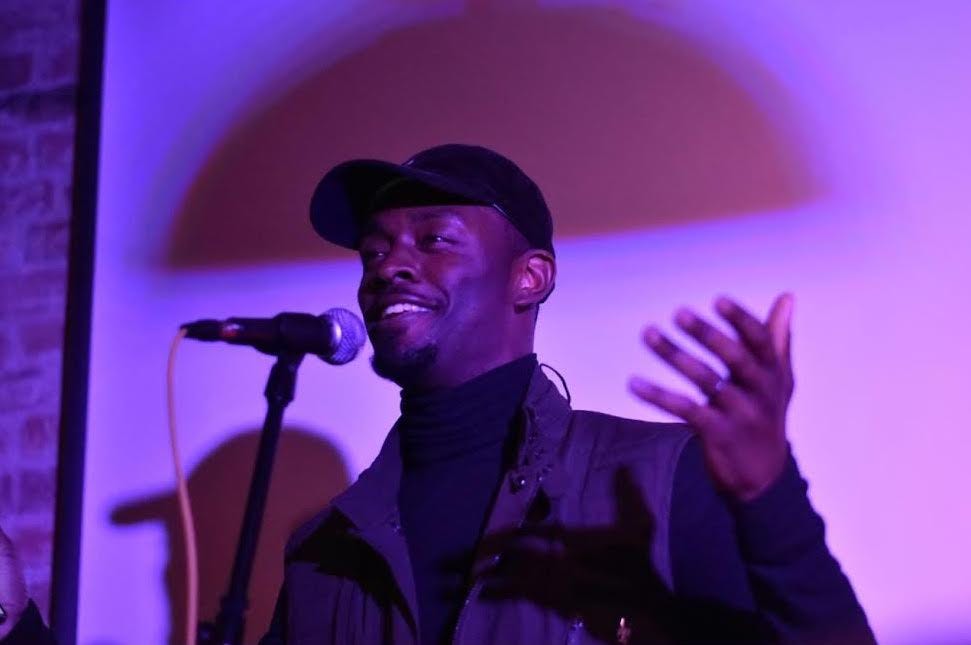
I recognized my favorite readers from October: Constantine, who hosted an Antifa reading series at the illegal bar, read a poem about caring and pretending to care about aspects of their university teaching job. I told them that if they were ever in New York, I would try to get them booked to read somewhere there because I thought their work was brilliant. I hope I didn’t come on too strong. I assume they remembered who I was, but if not, that would be even more offputting.
This time I came second in two rounds of “Rooftops and Flats.” My victory is imminent.
Between halves, I stood outside with Lechiek, trying to convince him to come to RSO, my favorite club, with me after the reading. I told him it was my last night there, that he should forget his wife, who was already impatient for him to go home with her. He said he was wrong about me, that I was actually evil. I told him no, no, I’m just whimsical, remember? I thought I had him convinced, but he left with wife and dog before the third half. I texted the friend of a friend who was always down for a club and asked if he was free. He said he would meet me in an hour.
The final reader of the evening was another I recognized because he wore red, heart-shaped sunglasses. I had gone to his birthday party at the illegal bar in October. I do not know if he recognized me. I kept making eye contact with him and half-smiling and wondering. The theme for the reading that night had been “steak too juicy, lobster too buttery,” and practically no one had attempted to make sense of this in a poem. Heart-shaped-glasses finished his poem with this phrase. The host who had come up with the theme had just jokingly complained to us that no one had been on theme, save a poem that mentioned lobster. So this was an especially victorious end to the third half.
Back outside, I talked to a friend of the Kim Possible girl, who I remembered from October and another girl who, in a twist of fate, recognized me before I recognized her.
Another girl, whose deadpan reading in the third half had amused me, was walking inside past us, so I stopped her to compliment her reading. She was surprised. She said she had been nervous. I told her I couldn’t tell; I didn’t think her deadpan delivery read as nerves. Somehow the group around us dispersed, and we were left talking alone. It was a rare occasion where talking to someone felt as natural as if we had been friends for years, despite having met minutes before. She gave me a strawberry candy I’d never heard of, and when I mentioned how cold I was, we went back to her nearby apartment to wait for my friend to go to RSO. She played music on her desktop and made us tea and I judged her bookshelf and she gave me a copy of Harold and Maude and let me see the separate bookshelf of all her favorite books. She took me up on my invitation to come with us to RSO, but the rest of that night is another story. I left Neukölln that night once again feeling like this open mic had somehow allowed me to connect with people in ways I didn’t believe I, specifically, was capable of.
Last August, when I had been to Berlin Spoken Word just once, I texted my friend, “Make Writers Losers Again.” We were complaining about Dimes Square, I assume. It is unusual to be in a group of people who seem cool and worth talking to without seeming intimidating, cliquey, unlikely to want to talk to you. That’s what I found at Berlin Spoken Word. In a literary scene that, much as I love it, feels more and more infiltrated by people interested in looking like a writer rather than in writing itself, this community feels especially singular and crucial. It’s a different type of exclusivity. You don’t need to make it on any kind of clout-based guest list to be there or to read, but you do need someone to invite you in, give you the key to the city’s literary world, because it won’t reveal itself to you unless you first show someone that you belong there. That you care.
 | A guest post by
|
Hey, I ran BSW for 5 years, and I remember the piece you did back at Biergarten Jockel, right before I retired from organising. What an astonishing review, thank you so much 🥲 so glad you've been coming back, and I hope we run into each other again when you're back in town.