

DISPATCH: Midsummer's Evening: Bernadette Mayer’s Golden Book of Words Re-Release Celebration (Oakland)
Her work carried through the voices of friends, family, students, and admirers

On the way to Tamarack, a lefty community space in Oakland, I was listening to Messiaen's early works. I headed over after spending a few hours scanning articles from a Chinese film journal called Popular Cinema, which I'd been thinking about since March. Mostly it happened because I'd received an email that morning saying the journals were "long overdue" and I decided I finally had to return them. Getting off BART, I saw an ad from the Alameda County Immigration Legal and Education Partnership with information about rights (you don't have to open the door, you don't have to answer questions, you don't have to sign any documents) and a phone number to call if you see ICE. It's 510-241-4011. Elsewhere in Oakland that day, there had been a protest against the California Highway Patrol's chase policy at the CHP office in the morning and one at city hall in the afternoon. One of these chases killed a high school teacher named Dr. Marvin Boomer, Jr, two weeks ago. He was popular and well-loved, which shouldn't matter.
Of course it was a beautiful day.
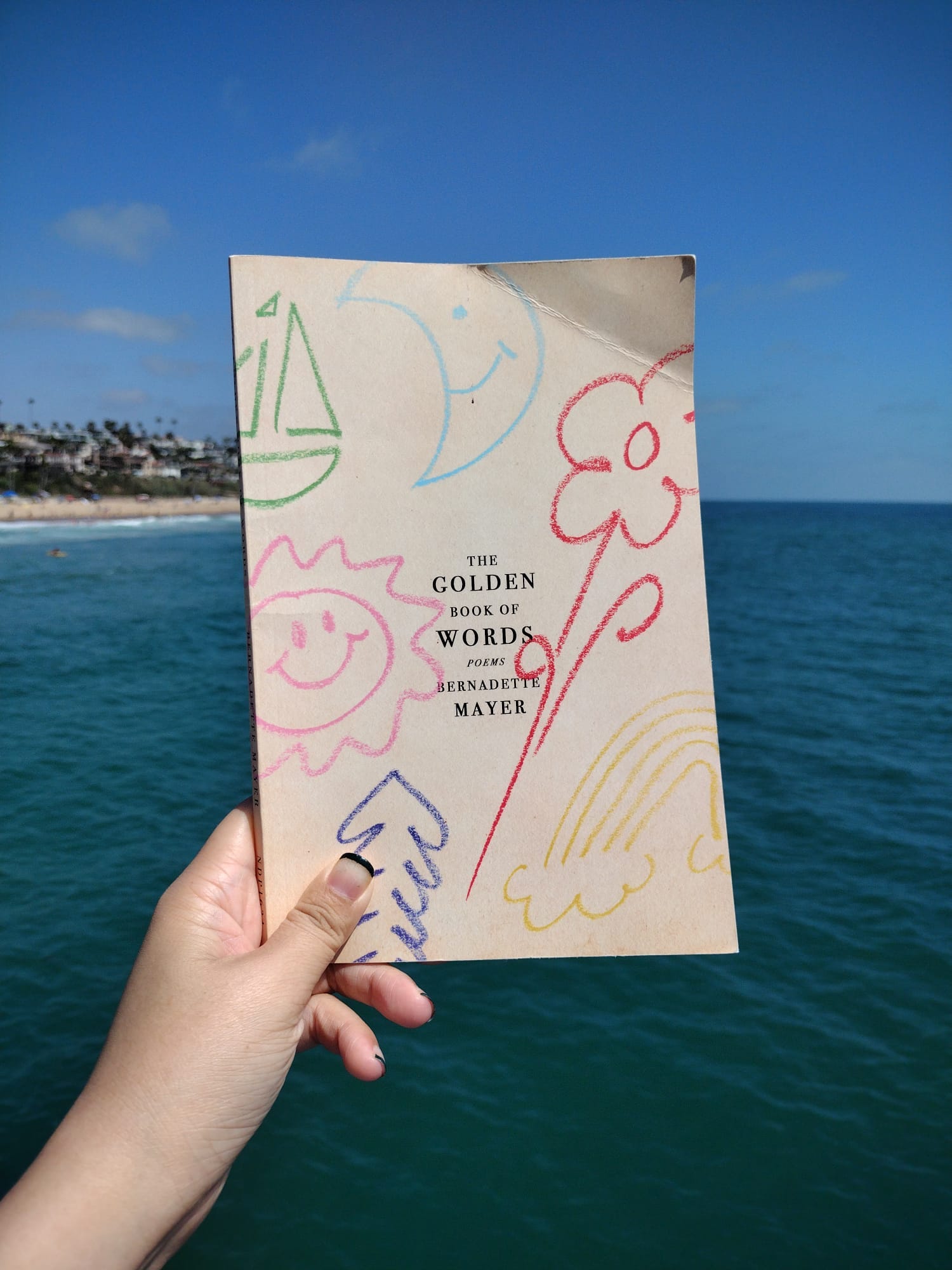
It was Friday the 13th, and we gathered to celebrate the re-publication of Bernadette Mayer’s The Golden Book of Words from New Directions. The event was put together by Sophia Dahlin and Sophia Warsh, Bernadette's daughter, as part of a weekly poetry reading series at Tamarack organized by Sophia Dahlin and Violet Spurlock. Sophia Warsh made gluten-free "Golden Bread," a cheddar and chive cornbread, and others brought an almond cake, chips, and strawberries. As I approached the table, someone told me, "The strawberries are incredibly sweet," and they were. It was so true I didn't know what to say. I just heard the words come out of my mouth: "Oh my god, they are."
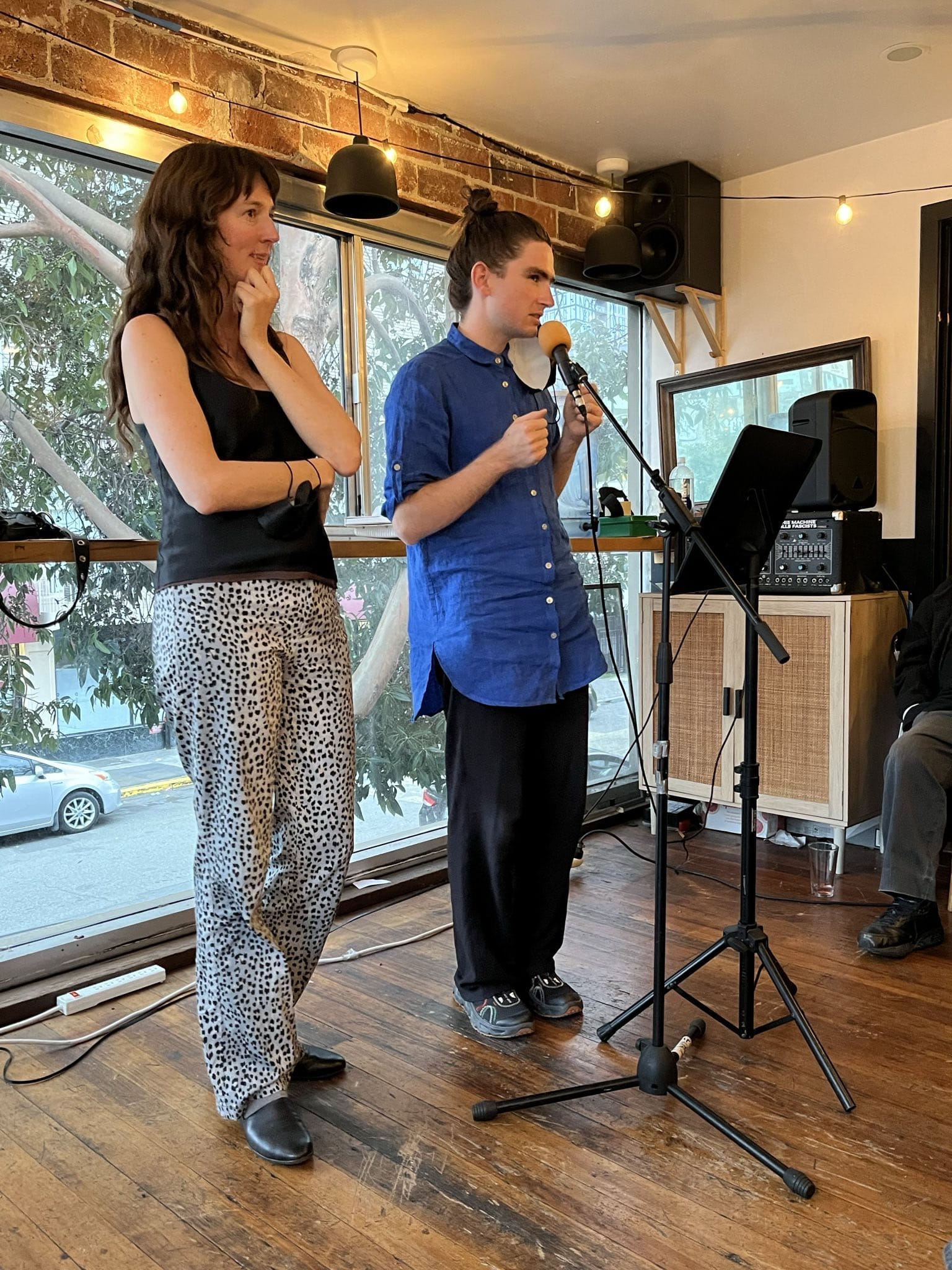
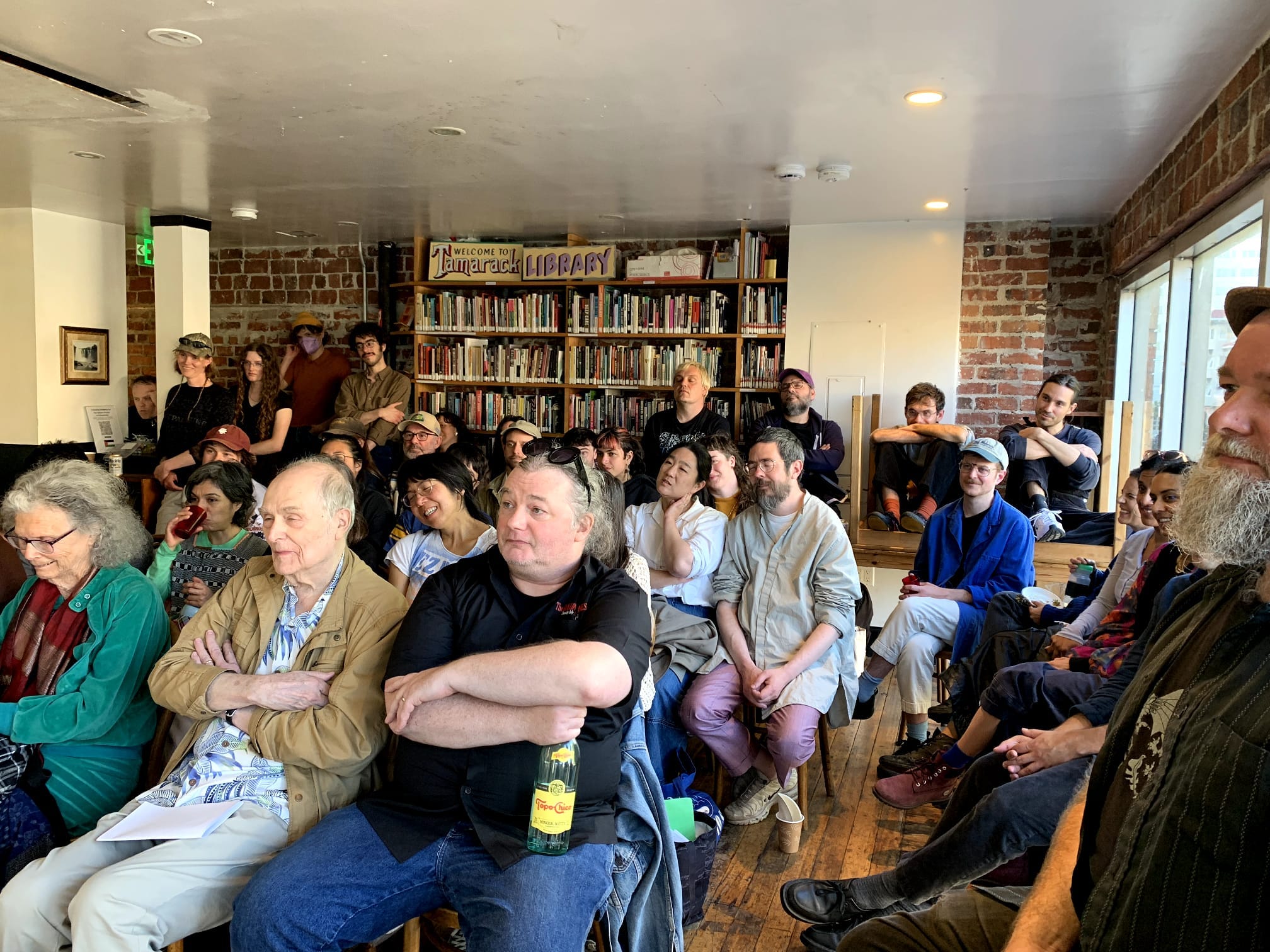
I'm calling her Bernadette even though it feels weird —unlike many people there, my only connection to her is as a reader—though it would feel stranger still to write about this reading and call her Mayer after hearing her work carried through the voices of her friends, family, students, and admirers, each reader awash in golden-hour light during strawberry season.
Sophia Warsh opened the reading with the first eponymous poem from the book, “The Golden Book of Words” and “Passover Pleasure," smiling in recognition of herself as "the willful, intransigent / and unpredictably regressing baby / born in November's first isolating blizzard." She mentioned her love of New England, where she was born to Bernadette and Lewis Warsh and still, she said, her favorite place.
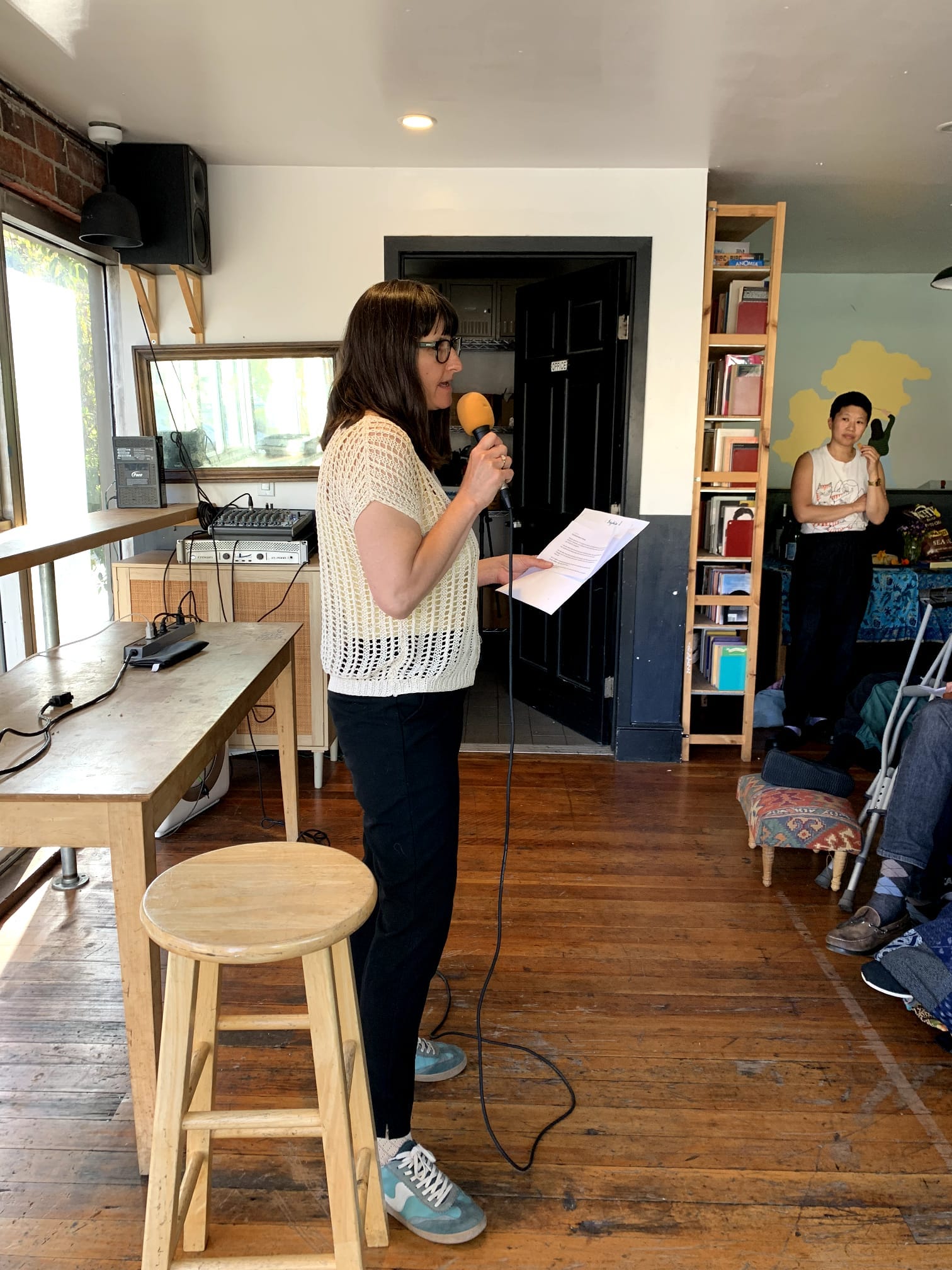
Jason Morris read next, summoning improbably "the snow" to California in June, which is a refrain in "End of Human Reign on Bashan Hill." He said, "Hey, the snow, you forget," and I remembered reading all of Midwinter's Day on my phone stuck in the snow in a mountain pass on the way to Tahoe on January 14, 2023. The roads were closed. There was no signal, and indeed, "the main thing was—NO PLOW!" There I read Midwinter's Day for the first time and began to write in a notes app. Reading Bernadette makes me want to write. The second poem he read was "Instability (Weather)." When he said, "I would eat a lilac if it were a violet," I glanced at Violet. I’m sure I was not the only one.
All the poems gestured outward, to the weather and babies then — and to the weather and memories now. Garrett Caples read “I Could Eat a Horse”—" no lilacs yet though I've been writing about it since / February"—and “Carlton Fisk Is My Ideal,” noting that he and Bernadette had somewhat different attitudes towards Carlton Fisk before he told us how she felt about "the beautiful skin of his neck." Sophia shared that there was in fact a photo of Carlton Fisk in a prominent location in their home.
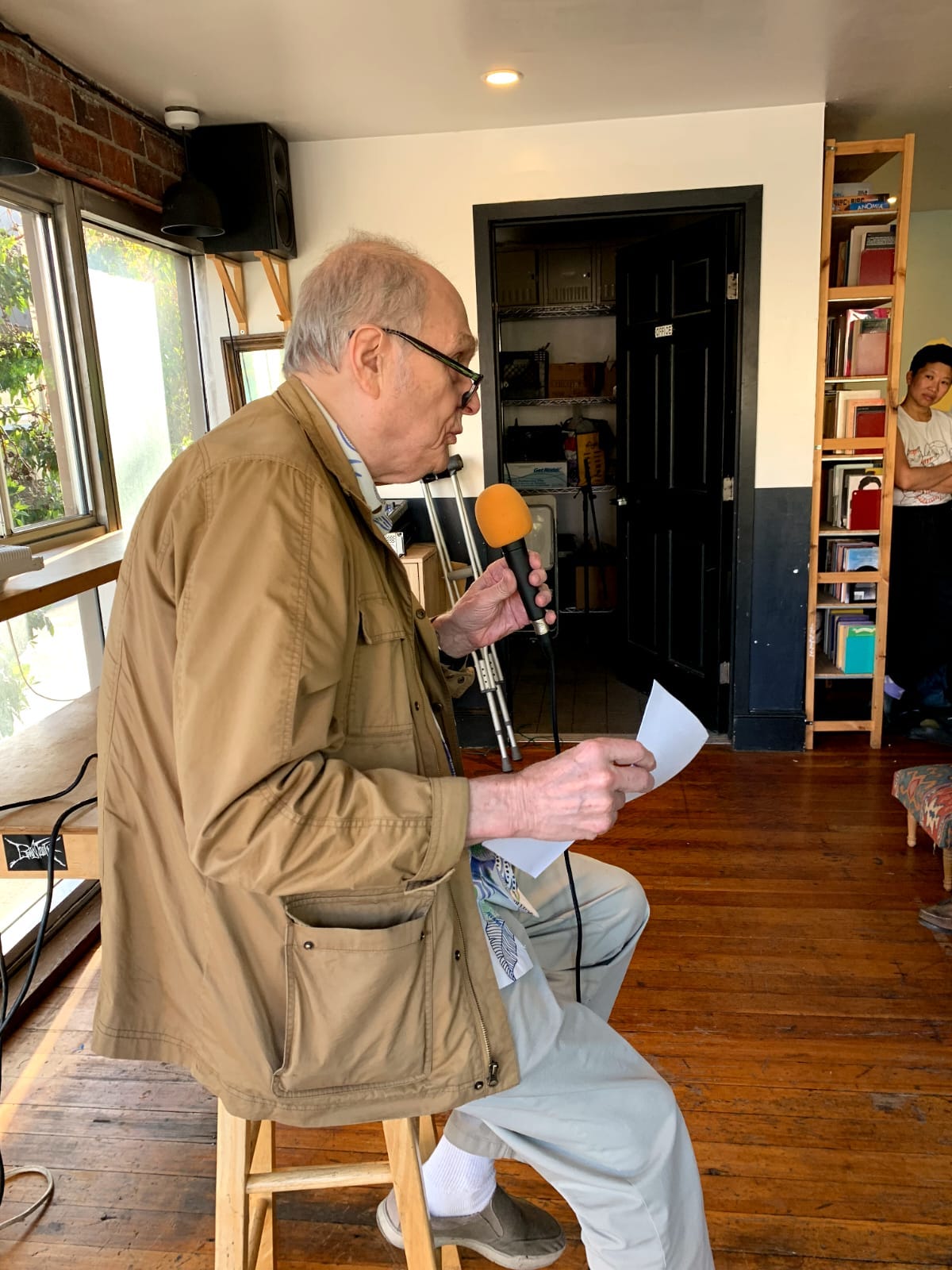
Clark Coolidge explained that he chose two different types of her poems: the short lines of "What Babies Really Do" and the long, streaming lines of "I Imagine Things," the type of poem, he said, he and Bernadette would push each other to write in the seventies. We laugh at "Eating doesnt go with prose / or poetry, spaghetti maybe," and I feel insane hearing "I feel I'm not a good poet, I'm half a poet, I lose my poethood, I don't compose knowing enough, I don't go far enough away, I'm too close to myself, I don't lose myself enough, I must free the language more, I free it too much, and now it's lost," but what an ending to all that.
Jocelyn Saidenberg read “June Dodge” and another poem called "To the Politician," which she found in a folder she kept from when she studied with Bernadette in the nineties. It was a copy from a single-user magazine called Dada. It's unclear which politician Bernadette was addressing at the time, but my mind ran through a pretty extensive list of names. You can actually watch Bernadette read it in this video here. Many such cases, as the target of the reading in this video famously tweeted.
We return again and again to her thoughts on what poetry is, who can write it, who can be written into it, with the fishermen in “Serial Biography” (read by Tausif Noor) and the "fine smooth mothering wind" in "Abou" (read by Ana Cecilia Alvarez). She poses the question of whether motherhood is irreconcilable with poetry, and answers it herself with a resounding no throughout her work and especially in “Baby Come Today, October 4th" (read by Stephanie Baker). October 4th was the day that "the second baby," Sophia Warsh, was due, Baker informed us with a smile. Baker starts off, "Ecstatic experiences with nature," and we the listeners all laugh.
So far I haven't really emphasized something we all know which is that Bernadette Mayer was so clever and so funny. Gillian Osborne read "Simplicities Are Glittering" next, in which Bernadette writes, "I speak to you as Proust, I can't be brief at all." (Clark Coolidge also makes an appearance in this poem.) Bernadette mothers the male greats in "Eve of Easter," which Sophia Dahlin read to more laughter, telling us how "Hawthorne will want to be nursed when she gets up" while "Melville sucked a bit and dozed off."
The third Sophia of the evening, Sophia Wang, who wrote a dissertation chapter on Bernadette and created a dance piece with her poetry, read “Sloppy Love." The poem begins by summoning spring but channels also the spirit of the evening in "I remember reading somewhere people use poetry / To wrap up things at the bakery, that's from / Cyrano de Bergerac, so the poet gets back / By letting other writers eat cake for free."
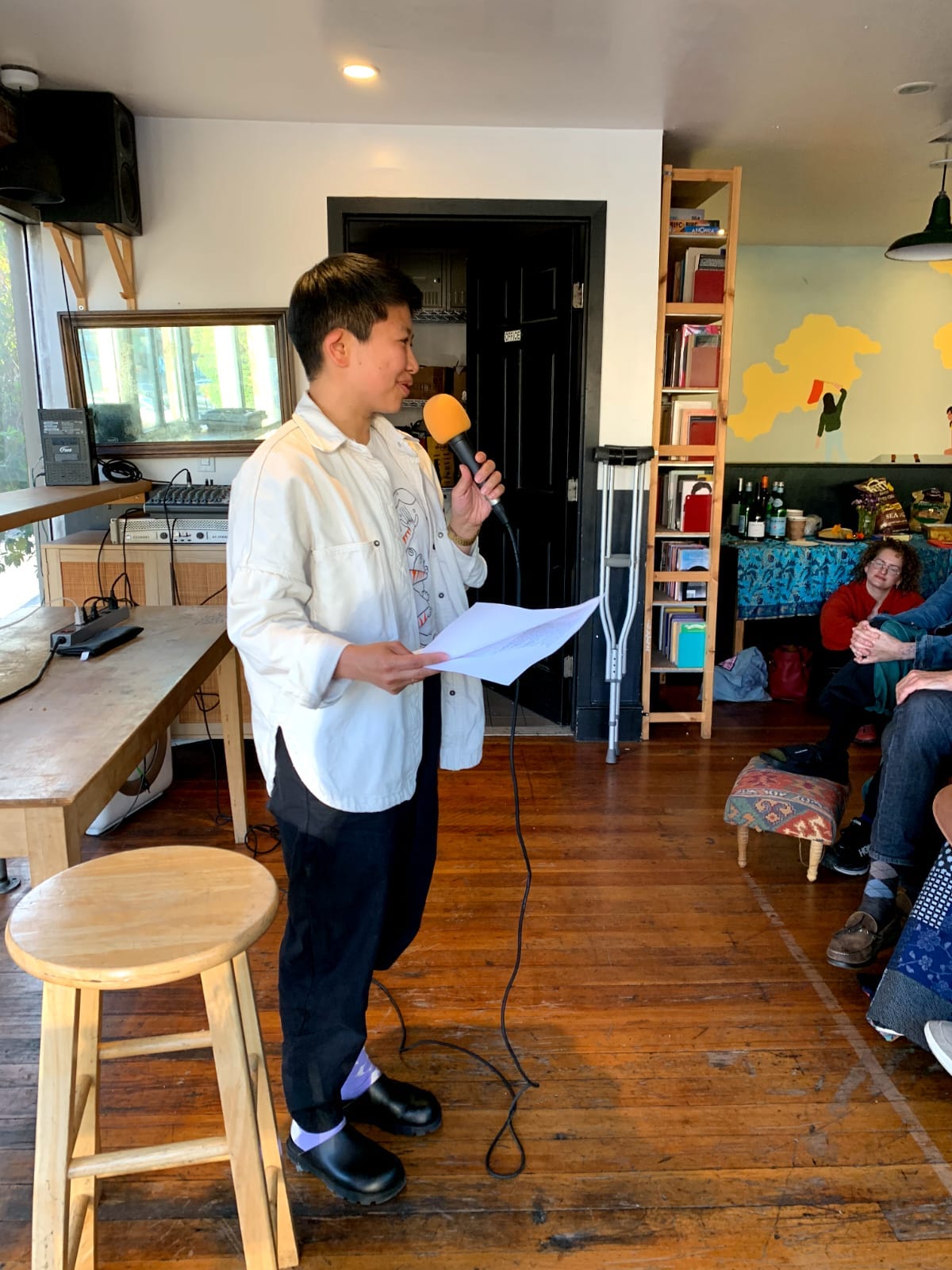
The final two poems left us with some wishes. The first wish is expressed with a sigh. Stephanie Young uttered those familiar words from "Essay": "I guess it's too late to live on the farm." Although the poet lives "more momentarily," Bernadette concedes, "than life on a farm would allow." Lastly, Willa Smart concluded the evening's celebration of Bernadette's life and work with “Hell at Last, Yawning, Received Them Whole." Towards the end of the poem, she paints a utopia: "And a pocket of poets everlastingly / disarmed the garbage government of fierce corrupted language / All men and women were free to sleep and dream a reverie."
Leaving Tamarack, my friend mentioned in passing there are strange resonances between the Korean American poet and filmmaker Theresa Hak Kyung Cha and Bernadette Mayer, two poets who seem utterly different even though they were both working in the 1970s. I probably should have asked follow-up questions because I still don't know what he meant. Nearly home, I heard and then passed by the East Bay Bike Ride, a fleet of bike spokes studded with colorful lights. I realized, for the first time this summer, that the sun had not yet set at 8 p.m.
 | A guest post by
|
i read somewhere the other day that ‘Sophia’ is scientifically the most beautiful girls name in English … and now this!