

DISPATCH: The Getaway Reading Series (Lincoln Square, Chicago), Behind the Curtain
Poetry and tarot on a Sunday night


The Getaway in Lincoln Square looks like a place you might pass without noticing. I almost did.
Standard brick storefront. Soft sign. Holiday lights still clung to the windows like they hadn’t been told the season’s over yet. From the sidewalk, it reads as a neighborhood bar doing what neighborhood bars do on a Sunday: staying open, staying warm, not asking much of you.
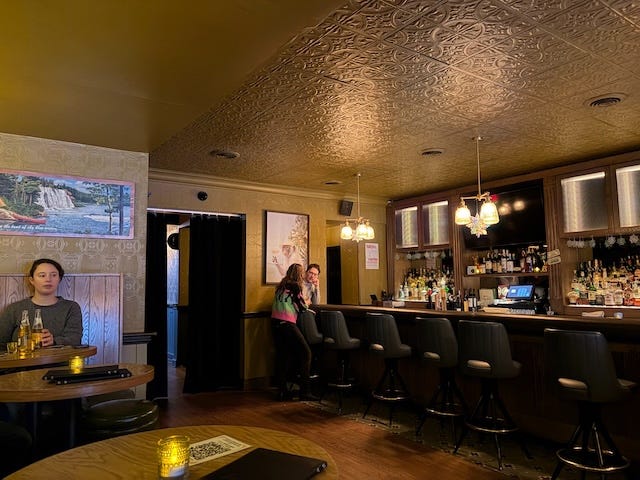
Inside The Getaway, the front room is chill. Gold art deco looking ceiling. A few people at the bar. A nameless person drinking like they’ve got nowhere else to be and clearly have no idea why random people are slowly trickling in. Nothing vibes that anything is about to happen.
The reading isn’t broadcast throughout the bar. It’s concealed from the ordinary patron who isn’t there for a reason other than getting a drink.
But along the back wall, there’s a dark curtain. You can see it from the bar if you’re paying attention. It doesn’t block sound or light entirely. It just suggests there’s something behind it. Discretionary. Biding. Teasing you to peak in.
I must admit at this point that I’ve always associated curtains with David Lynch, even when I don’t mean to. Throughout his career he methodically used them as symbols of tantalizing psychological punctuation. A curtain is never just a curtain. It didn’t mean privacy. It meant something else was operating here. Another set of rules. Another kind of vibration.
He was infamously obsessed with The Wizard of Oz, the most literal version of that symbol. What’s beyond the curtain? A shift you don’t earn. A world that refuses to explain itself. You’re just abruptly in it.
Curtains make that kind of transformation feel voluntary. You’re not dragged anywhere. No one pushes you through it. You pull it aside yourself. So I did just that..
Once I did, the room opened up.
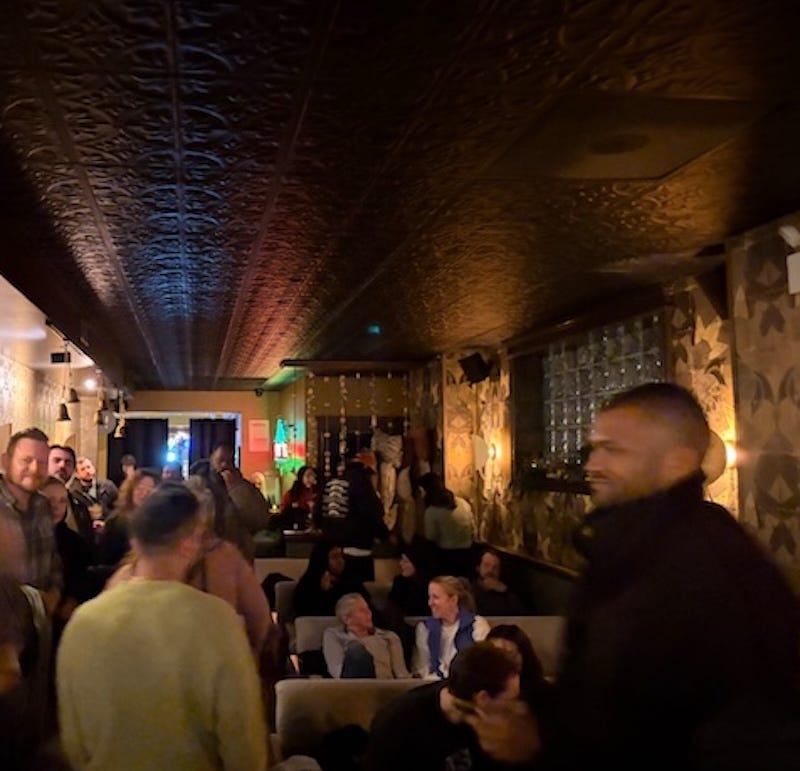
Couches laid out like pews at a church, comfy chairs you could sink into, and small round tables with battery lit candles. A stone fireplace that people were already chilling at. Wallpaper that actually felt intentional. And a microphone set up like an afterthought in the middle of a square batch of tile on the floor used as a makeshift stage, just enough room for a body and a voice.
It felt separate without being sealed off. Like you could leave at any time, but why the fuck would you?
Before the reading started, Kate Bush came on. “Running Up That Hill,” loud enough to feel slightly absurd for a sound check, then fading back into background music. People talked softly. The room hummed. Casual, but not exactly loose.
There was a tarot reader set up near the fireplace. Paige Shano. She was already part of the space, before it truly became one. Just another presence among the couches and chairs.
I went over to her more out of habit than belief. She asks me to choose which stack of cards I want her to pull from. Whichever one my energy felt drawn to. I pick one without thinking too hard about it. In hindsight, I’m fairly certain the red color and occult vibe is what drew me to that deck.
She pulled a card.
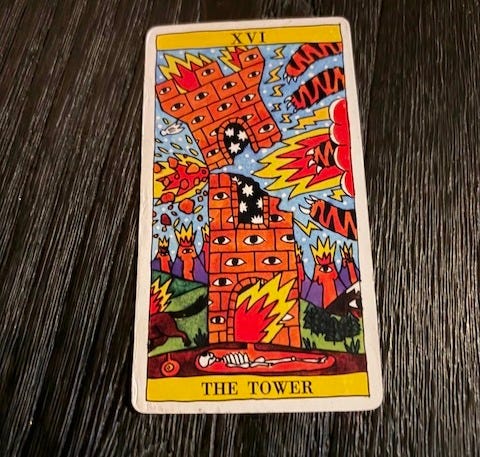
The Tower. Crumbling down with fire and a skeleton at the bottom.
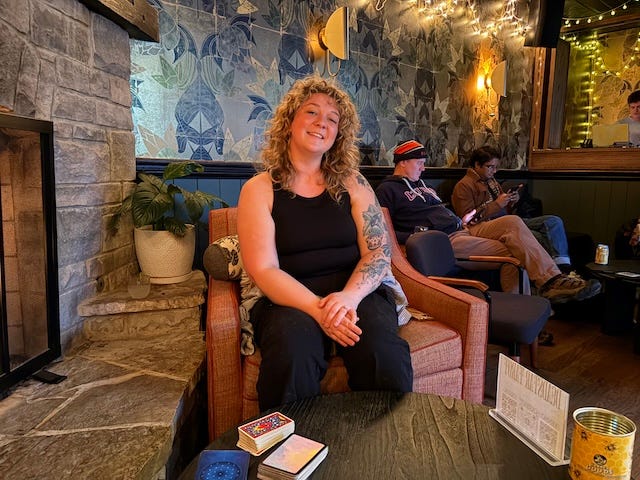
She went into explaining the meaning of it to me as if I didn’t already vibe that it wasn’t the best card to get. It represents collapse, sudden change, and false structures coming down. The thing you thought was holding everything up turns out not to be doing that at all. It falls. Loudly or quietly, but either way it goes.
What surprised me however is that she didn’t make it sound ominous. She assured me that sometimes it’s necessary. That some things actually need to collapse in order for true change to happen. That it’s not always a disaster so much as a correction.
I nod like I’m politely indifferent on the subject. I don’t really get into astrology or tarot or palm readers. But for some reason, whenever it’s around, I always try it. And no matter how ironically I go into it, it always seems to land a little too close to whatever’s already been unraveling for me the past few weeks.
She slid the card back into the deck. When I ask if it’s okay to mention her in Zona, she gets visibly excited about it, which is oddly reassuring after all that talk about collapse.
When we wrapped up, I snuck back to the couch I was lucky enough to secure earlier.
I’m a corner dweller by nature. A wallflower. I like edges. I like knowing where my presence ends in a room. That couch was the only free space left when I arrived though. It was either that or stand around awkwardly. One person was already sitting there. I asked if they were saving it for anyone. They said no. I sat down quickly, trying not to make it a bigger deal than it was, knowing it absolutely was.
As the reading got closer to starting, more people squeezed in. The couch filled up other people with drinks and winter jackets. As one person put their drink down on the round table we were lucky to get, I noticed that our votive was glitchy. Sometimes flickering. Sometimes lifeless. Shoulders touched. Legs bumped. No one complains. The room compressed in a way that felt cooperative, not tense.
Almost no one is on their phone.
I feel faintly douchey pulling mine out to take notes. Like I’m violating some unspoken agreement which eventually becomes spoken. I keep it low, half-hidden, typing illicitly, trying not to break the spell whilst also knowing I’d forget the tiny elements of what made this night feel so right, if I don’t jot it down.
Kat Freeze, the host, hung around for a while before the reading began. She definitely is the person that this event was orbiting around. If I didn’t casually see her read a few weeks prior, I might not have even known about this event. I wondered how many other readings she had done to promote this one. The crowd spent thirty minutes being present, talking, and existing in the space before she went up to the mic. When she introduces the reading, she starts with gratitude. It doesn’t feel scripted. It doesn’t feel false. It feels like tone-setting and authentic in a way that makes other hosts of readings seem less than genuine.
She laid out the ground rules gently and clearly. Silent phones. Don’t get up during a poem. Wait until a person is done reading before getting a drink. The kind of boundaries that would normally feel restrictive but instead made the room feel safer, more intentional. You could feel people agreeing to it.
The first reader was introduced in her setup and almost stepped up before Kat was finished. A small human hiccup. No tension. The room settles. I would’ve died if that was me, but this reader laughs and waits before she gets to his name.
Jitesh Jaggi.
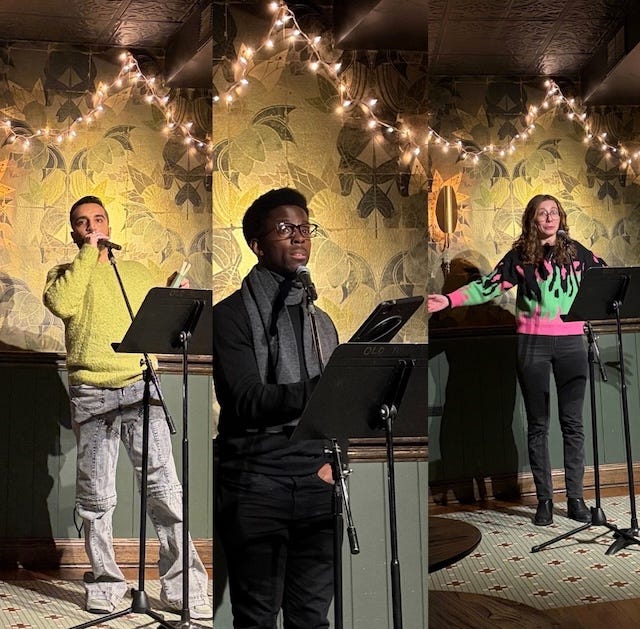
He opened with a poem about persimmons, which works because the word itself already sounds like a setup and he knew it. It’s absurd and precise and genuinely funny. The room laughs. He reads about ADHD and online shopping. He drops lines that stick with me: abruptly sweet. Another: where would it be if it were not.
He joked that he loves that he couldn’t see us because of the lights, then gestures to one side of the room and says he could see them, but that’s fine. He reads a poem about Pitbull, gym bros, and the strange nirvana of not having AirPods in at the gym. There’s a line about how everything has a deeper meaning when you aren’t listening to Conan O’Brien and I’m struck by how everyone has a podcast these days. He was humble but funny. He knew when to lean into humor and when to fall back. When to be sincere and then turn it into something we could all laugh at. The perfect example that poets are really just standup comics who are sad.
He closed his reading with a poem written by Renée Nicole Goode. I realized then that I’d been half-hoping for a night where I didn’t have to think about ICE at all, a quiet, selfish desire for a getaway in a bar named exactly that. I’m aware that wanting that is its own kind of privilege. But even that small luxury doesn’t hold. Not there. Not behind the curtain.
From the bar out front, “Fade Into Me” started playing and he was done.
At some point, I realized the room that was once almost empty was now full. Standing room only. People leaned against walls, hovered on armrests, sat on the floor in the front, bodies angled forward. Almost no phones out. When the ground rules were made in this space, people actually listened. When people spoke, it was only to hype the reader, not interrupt them.
Jonathan Boyden went next. He had the posture of a seasoned reader who had a chill presence that could match any room that he entered.
Someone toward the back shouted “J-Bizzle” mid-reading. It’s chaotic but affectionate. Jonathon reads a line about hide and don’t seek that lands harder than expected. He was performative in a way that felt practiced but not slick. He had a holder on the back of his iPad that freed his hands, and it mattered. His poems came in quick, micro-sized bursts. The room stayed with him and for a while it feels like we’re all in a kind of Lynchian trance.
I break the spell slightly by putting my drink on the table a little too loudly and realized that our candle’s glitchiness was linked to movement. The classic have-you-tried-hitting-it situation.
The tarot reader, Paige, is now upfront and I check my phone to see if she was listed as a reader. Instead, she was there to introduce Kat Freeze as the final reader. Give her credentials and mentions that was published by Bottlecap, the first place that ever published me. She had my attention even more than she did before hearing this.
Kat reads and, at the end of each poem, takes a small step back. Just enough to create space. Like with each step she was resetting. She read about where all the “cool” poets went when they had their mental breakdowns in contrast to the lame places in Chicago. Got into certain subjects that I thought were lost to poems in the early 2010’s and ended with a poem about a suicide she witnessed at Water Tower Place. The room got very still. I even put my phone down during this one.
A collective sense of “that was fucked up” seems to be shared. A wild way to end a set.
There was a Miranda July–adjacent quality to her delivery, but not in a way that felt imitative. More like a willingness to let discomfort exist without smoothing it over. She said lines that stuck with me just like the others. My favorite being: what is left without the pain.
I thought again about my tarot reading and The Tower. Not collapse as spectacle. Collapse as invitation. I let the feeling wash over me. It felt otherworldly.
A room behind a curtain that keeps asking to be pulled back.
And the silken, sad, uncertain rustling of each purple curtain
Thrilled me—filled me with fantastic terrors never felt before;
So that now, to still the beating of my heart, I stood repeating
"'Tis some visiter entreating entrance at my chamber door—
Some late visiter entreating entrance at my chamber door;—
This it is and nothing more."
from Poe's "The Raven" (1845)
(N.B. spelling of "visitor" as "visiter" is as intended by EAP.)