

ESSAY: Being Boiled
David Foster Wallace, Jordan Peterson and the Infinite Promise Of Pain


Two writers holding positions of generational influence are weirdly connected through mutual empathy for the lobster – but they diverge on the lessons it can teach us in how to deal with the pain of others.
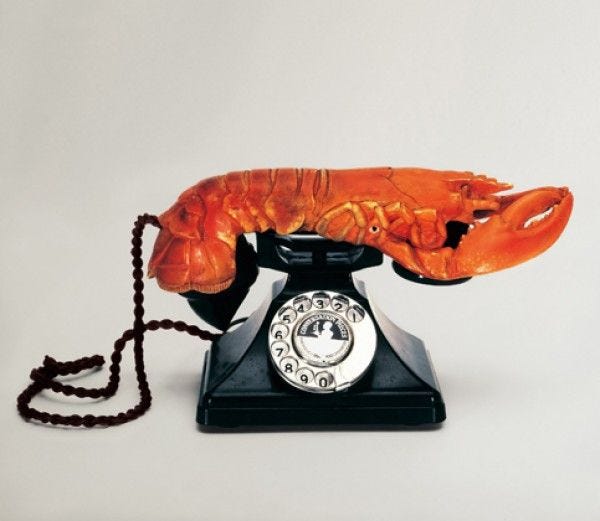
He eyed the peculiar shapes that lay across the trousers indifferent for a while, until it occurred at last how strange it was that lobsters should sit there then he was suddenly ceased with a terrible loathing for lobsters and flung them away so they cracked on the rock the dull pain of the blow extended him into them again and they became his hands, lying discarded where he had tossed them.
-Pincher Martin, William Golding
In 2004, David Foster Wallace attended the annual Maine Lobster Festival for Gourmet magazine, writing a famous essay ‘Consider The Lobster’. He appears to approach the event with the ironic disdain he wrestled with throughout his life, and in his most popular novel, Infinite Jest.
Trapped in the commercialized grotesquery of the ‘Eating Tent’, Wallace has his naked lunch moment: forcing us into a confrontation with hunger versus greed. He steadily piles on a heap of statistics: the amount of lobster that will be consumed over five days, the number of tourists who will flood the Harbor Park area, providing a neat pound-of-flesh to pleasure ratio, weighted against immeasurable crustacean suffering. This expresses the clash between ultimate pain and maximum leisure: death for the many unfortunate lobsters set against the festive gluttony of the human attendees.
The essay builds to a sincere slow-burn argument that we should reconsider the lobster, and our carnivore status; hinged on the innate human contradiction of holding moral views that do not align with our ethical choices — where the true cost of individual happiness often comes at the expense of others.
Jordan Peterson takes a psycho-chemical-reactionary angle putting his faith in the serotonin levels of lobsters—suggesting that we have more in common than we might expect. But where Wallace is interested in our mutual capacity to appreciate pain and suffering in others, Peterson employs a sympathetic angle as brute rhetoric; aligning humanity closer to the particular behaviors he wishes to promote.
Peterson finds a more symbolic empathy for the lobster as human archetype for physical force and macho posing. In his 2018 self-help book, Twelve Rules For Life: An Antidote to Chaos he claims that both human beings and lobsters are innately competitive, a predisposition which is borne out in our societal models. Peterson cites the savage infighting displayed by lobsters when pitted against one another, framing a state of nature existence. In Peterson’s corollary, the most aggressive creatures can rule by might alone, and without compassion, asserting themselves rulers–kings amongst lesser men in the social hierarchy; the man with the biggest claws who knows how to use them wins.
He has a point, but Peterson misses the lobster’s potential for a shared sensitivity, which bats against his univocally combative lobster-mensch. Wallace notes that lobsters are solitary, independent creatures. When held captive in the brightly-lit glass tanks of the restaurant; what we assume is a pleasant space closest to their natural spaces, they will always crawl away into the darkest corners to be alone. The reason lobsters have their claws tied with elastic bands is not so much that they will snap at our fingers, it prevents them attacking one another when held in close proximity, a stress reflex that might damage the living cargo.
Wallace notes that many, himself included, might disagree with lobster consumption out of principle. He highlights PETA commentary that “lobsters are extremely sensitive” as they meet the Lobster Festival with an annual organized protest. Only recently considered a kind of delicacy, Wallace highlights the lobster’s true status as an ancient, insectoid crustacean – cannibal scavengers – they were emergency food for Dust Bowl settlers, caught, canned and shipped out West in the 1930s – an underwater ‘bug’ in the original vernacular of the Maine fishermen.
He argues all meats are one generic victim flesh. Choosing to eat one animal, but not another, means that we don’t truly disagree with the principle – we just choose when and where to care. Admitting to our crimes shows remorse, but does nothing for its victims, such as the lobster. Comfortable in our own double-think, we create a safe space in which to thrive: my enjoyment, my lack, my hunger, my pain is more important than yours; a principle of living that congeals into the death of affect – when we cease to care about the pain of others, we soon stop noticing it.
TASTING NOTES
A case in point, Wallace factually records how a lobster dies: tossed into a pot of boiling water with the lid placed on, the lobsters clanking around beating against the sides. Among these acts of resistance there is the folk-science claim of the lobster’s ‘scream’, actually heated seawater escaping from inside their carapace; doubly painful as the lobster is scalded inside and out.
It is this ritualistic experience of kill-cooking, not so much the aftermath of consuming the lobster, that causes people to escape the scene, knowing that even in their absence the ghostly pale flesh is being turned to a burning shade of pinkish white. The lobster takes at least ten minutes to cook around 30-60 seconds to die – it is in this drawn-out window of time we are expected to find something like sympathy for the victim, to put ourselves in the pot.
Certainly, humans pride themselves on our ability to think and make considered choices – not just acting by feeling or instinct, a distinction meant to separate us from the beasts. Wallace sees something particularly human in the lobster’s desperation. He mentions them grabbing at the edges of the boiling pot, a reflex action, mingled with something like fear – the act of resisting death–all carries the appearance of choice – of not being boiled.
MUTUAL DIFFERENCES
A common defense of lobster-eating is to argue that they have no cerebral cortex, so lobsters do not undergo the emotional experience of pain, what we might call suffering. But Wallace argues that pain is a basic primal reaction – it bypasses the cognition of the brain completely – shooting through the nervous system as pure sensation. In human terms, he compares this to burning our hand on the hot stove and the knee-jerk reaction to remove it as quickly as possible. The by-word for this second nature reflex might be pure instinct; a feeling, that is also true, must therefore be real.
Peterson makes a drastic shift away from homo-sapiens’ closest (living) animal cousins, the chimpanzee, offering a slanted slice of pseudoscience which suggests that male lobsters that appear the most dominant produce more of the neurotransmitter and hormone serotonin (broadly known as the ‘feel-good’ brain chemical). From this he concludes that when people “slump around,” like weakling lobsters, they are displaying signs of lowered serotonin, which will inevitably make them even more unhappy. Peterson’s story about the lobster is exactly that. He wants his most forlorn reader-followers to embrace a positive, assertive forward-looking attitude that cuts against the background darkness of life. But the end result is always the same: to embolden themselves with a combative self-image, as once heroic fighters beaten down; Peterson wants them to be strong, and to compete; embracing his view that life is a race from the bottom to the top, by nail, tooth or claw.
Speak your mind. Put your desires forward, as if you had a right to them — at least the same right as others. Walk tall and gaze forthrightly ahead. Dare to be dangerous. Encourage the serotonin to flow plentifully through the neural pathways desperate for its calming influence.”
–Jordan Peterson, 12 Rules for Life
Peterson’s take depends upon lobster-ish similarities to justify self-absorption, over an awareness of the needs of others. But what about the pain of the lobsters studied by Foster Wallace? Where the minimum yield of physical pain is bodily damage or even death – how does this translate into a metaphor for emotional pain?
Stretching the lobster to its therapeutic limit: what happens when we try to dodge our pain – ignoring the root causes – something Peterson’s Twelve Rules would caution us against. Are we, then, just like the lobsters, tough yet vulnerable not truly sentient; living in denial forever putting off the simmering pot of water, retreating to the neurasthenic ‘happy safe place’ of the penguin in a cave found in Chuck Palahniuk’s 1997 novel, Fight Club? Peterson’s definition of life as naturally brutish expects more than survival, we must overcome others, but without fully understanding why.
“Sometimes human beings have to just sit in one place and, like, hurt”
–David Foster Wallace, Infinite Jest
“To suffer terribly and to know yourself as the cause: that is Hell.”
–Jordan Peterson, 12 Rules for Life
In William Golding’s novel, Pincher Martin (1956), we follow the eponymous protagonist marooned upon a rock in the middle of the ocean, fighting to survive and each day reminding himself, ‘Tomorrow I shall be rescued’ without realizing that he is already lost. An existential motif perhaps, but taken as read, Martin rejects the repeated offer of spiritual release in favor of straight denial. He knows that his daily pains are simply grist to his cathartic drive, the struggle of survival is character-forming, it forges chastening scar tissue. After all, what is the point of enduring pain (against the impossibility of suffering) if it doesn’t make us harder/faster/stronger?
This was the addict’s dilemma posed by Wallace though Infinite Jest. You live two lives, pre- and post-recovery – the latter will forever be hinged upon the former. Without this we might go on repeating the same mistakes expecting different outcomes. There must be an awakening – a ‘bottoming-out’ of deep trauma. Pain swells are the body’s warning signs – prompting us to action – or else death.
In contemporary therapeutic terms more aligned to capitalist accelerationism, changing our lives has been re-branded as “growth”; if you’re not constantly improving (Kaizen Chic!) are you really living? Along this jagged path we are sure to make more bad choices, but tempered by hard knocks and a heap of regret, we start again, and find moral certitude in the corrective power of infinite forgiveness, first for ourselves, and towards others, as an afterthought.
Peterson is the martyr of this dictum – and its worst serial-offender. His hard and fast rules go hand-in-hand with his congenital dishonesty and in believing his own hype. Out of anyone, he has drunk the most piss in his pool of Kool Aid. He lays claim to a deeper vulnerability because of his many flaws, the monsters we threaten to become, which places him at further remove from his own choices, while taking the long, hard conservative view to bigger issues of poverty, inequality and disenfranchisement – always pushing back against a culture of individual victimhood.
WATER, WATER, WATERS…
In his 2005 Kenyon College commencement speech, This Is Water, David Foster-Wallace makes a case for empathy as bigger, broader thinking. He emphasizes the value of university education – encouraging students to engage in critical thinking and active questioning – they are taught how to think, not what to think. Wallace uses his speech to highlight the danger of living too deeply in our private ego, at the risk of becoming disconnected from the daily struggles and pain of others.
The Austrian philosopher, Ludwig Wittgenstein once stated: “the limits of my language are the limits of my world”, citing the impossibility of making our private experiences publicly intelligible to others. He uses the example of slapping yourself in the face. We can all appreciate it must hurt – from a distance – but we don’t know how it feels. We cannot get inside the other person’s head, and they cannot fully articulate their pain, therefore empathy must bridge the gap.
Wallace makes a case for the empathetic imagination, as engineered by fiction; the powerful investment shared between author, reader and subject, which empowers us to learn about the experiences of others and how they might see the world, particularly where it differs from our own position. These imaginary lives we read through underscore the limits of our knowing – empathy takes up the slack – aiming towards an ideal of neutrality. The alternative to this is the anti-intellectual streak of the far-right parroted by Peterson: the vicious enthusiasm to strike-out the humanities, turn universities into generic business schools, and restrict academic institutions as places of protest, while crying out on the need for unlimited free speech – teaching people not to think.
Seeing people in a rush, going nowhere, stuck in traffic and hitting the horn Wallace emphasizes the negative impact of forcing our stress, pain and anger onto others, which only compounds as it is passed from person to person. Wallace preaches the need for an open-minded approach – to live through empathy, knowing we cannot change the world overnight, but in place of cruelty and fear we can be kinder in our choices.
In Infinite Jest, Wallace confronts us with the end-game of neoliberal individualism: “Everybody is identical in their secret unspoken belief that way deep down they are different from everyone else.” Peterson’s attitude demands we put ourselves first, above any notion of collectivity comes second place to our personal ambitions and desires, too social, too socialist, and is written-off as a weakness. This eventually manifests as deeper indifference and gradual alienation from the suffering of others. In his Twelve Rules For Life, He argues for inner resilience and self-care, with private responsibility as a priority, others are secondary, or even instrumental, to this:
“Treat yourself like someone you are responsible for helping.”
Appropriately, he warps the basic maxim of Christian charity, doing unto others what we would have done to us, edging towards the casual cruelty of making people a source of competition, expendable ballast to push against:
“Compare yourself to who you were yesterday, not to who someone else is today.”
A sentiment which chimes with Wallace, when in Infinite Jest, he makes an appeal for a base level of common consciousness, guarding against isolationism:
“You will become way less concerned with what other people think of you when you realize how seldom they do”.
For Peterson, any attempts at living for the other are treated with contempt, people are disposable and valuable as much as they are useful to practice self-improvement, he fears the infection of their Nietzschean ressentiment.
PALE KINGS
The modern challenge of David Foster Wallace has become whether to read – or explicitly NOT read – Infinite Jest, and how we might approach it. Since his death, Wallace has been savaged by critics, particularly for his life off the page. This has inspired a kind of boycott against the author – and by extension – the chimera of the Lit-Bro, who have taken up the book as an iconic totem in his wake. Wallace’s flaws loom large in real-life acts of abuse: violence, stalking, and coercion, behavior beyond the neurosis of the gifted intellectual to paranoid acts of cruelty, conveniently carried out in his ‘addict years’ of fame. The author Mary Karr claims that Wallace threw a coffee table at her, kicked her out of a moving car, and repeatedly stalked her. Wallace has (posthumously) become ‘That Guy’ – too keen, too needy, too intense – always going too far. Where passion curdles into obsession and control, empathy also flies out the window, as selfishness becomes coercion and violence – the recovered addict paints themselves into a corner of (in)convenience, identifying as someone who can transcend their mistakes, but never fully overcome their troubles.
Wallace’s litany of real crimes suggest he has more in common with his Lit-Bro inheritors than we might wish to admit, but more crucially, with bad-guys-at-large. Hard to understand and difficult to love; good at chess, bad at life – Wallace’s defenders ask us to grant him the elite status of the art monster; a creature of necessary terror captive to the tipping point of genius.
As a kind of inoculation to criticism, Wallace projected images of ‘bad’ people into his work; pin-pointing the kind of evil he saw in the world through his short story collection, Brief Interviews With Hideous Men (1999). These poison pen portraits occupy neatly fuzzy spaces, hollow identities, with details redacted and names erased – just vague enough for Wallace to remind us that there are monstrous people out there; ‘but I’m not like that’ (knowing full well that there is a part of us all that is just like that). This expresses the moral relativity typical of the 90s slacker malaise that Wallace tried so hard to overcome. He becomes trapped in the tautology of empathy: retaining self-knowledge of guilt but also trying to j’accuse the world:
“What passes for hip cynical transcendence of sentiment is really some kind of fear of being really human”
–David Foster Wallace, Infinite Jest
THE BROTHERHOOD OF MAN
An odd-angled academic turned influencer-grifter, Peterson made his millions, and much of his reputation, suckling on the tears of his vulnerable audience and crying them back in response. He excels at zeroing-in on pain, reveling in the little things that destroy us; his rhetoric keeps our cash-cow wounds raw and bloody, such that they are never allowed to heal. His scope of empathy seems boundless; his followers feel heard, seen, understood even, but his core message is duplicitous: You are responsible for your own mistakes, but it’s the System’s fault you cannot heal and grow. Accordingly, he keeps his foot on the culture war pedal, giving more fuel to his nihilistic bonfire of free speech for its own sake.
Where Peterson claims to identify with the continued growing pains of so many not-very-bright young men, to know their struggle from the inside out, Wallace aims to identify with a problematic subject, but always from the creative remove of earnest intellectual curiosity, just far enough so that none of the toxic splashback will touch him. Both authors aim to stand-in as the interlocutors, confessors and apologists; the lost mentor, father, brothers of Ian Curtis’ troubled young men: “the world on their shoulders”.
Such is the esteem of Consider The Lobster and This Is Water, perhaps equal to Infinite Jest, they further established Wallace as a humanist icon of cultish proportions. The scale and spread of his novel’s post-modern nightmare squares up to the self-help value attached to it: the idea that the mutual understanding a book generates should make you a better person – which simply isn’t there.
Wallace was one of the troubled young men of Infinite Jest. Although they were not all of a type, seeing their own weaknesses reflected back at them caused them pain, something Wallace never outgrew. His persona was of the survivor, the ex-addict who escaped the pressure-cooker of life’s great pot, carrying about his emotional scars for all to see. Wallace’s ideal of empathy has him tripping over himself to admit that we are none of us perfect, and this should provide moral slack to our choices.
He shares with Peterson the exaggerated attachment to the expression of empathy, choking on its smothering power and all-embracing hype. The risk of depending on this singular vulnerability is that it can be exploited into a new kind of armor, a moral swatch of anti-critical teflon: how long can you go on showing your belly, only to roll back over once people start paying you the worst kind of attention – reminding you of who you really are.
Peterson casts a shadow for others to follow – whenever he next fucks up – he professes inner flaws, humility, and the bondage of political correctness; the donations keep rolling in regardless, and it’s harder to tell whether he is still in it for the money, or just the attention. Equally, Wallace could not admit to his need for both critical praise and a popular readership, he wrestled to find his place in the post-modern deluge he tried to rise above in critique, and ground himself back to real concerns of suffering, empathy and a new openness.
If the lobster and other victims must be a sacrifice towards our free thought, a test of our faults, riding a wave of regret is not consequence enough to just go on excusing our actions. Learning to control our freedoms, particularly the need to devour the suffering of others for our own pleasure or gain, where freedom from pain is realised through the ability to own the bad choices we have made and actively live towards change.
“The truth will set you free. But not until it is finished with you”
–David Foster Wallace, Infinite Jest
 | A guest post by
|
I never thought that my history of being an avid Jordan Peterson watcher, and my history of having read a random essay collection by David Foster Wallace would put me into such a great position to experience a wonderful essay about empathy.
A year ago, a few co-workers and I did a "food science" experiment to see if lobsters could be killed very humanely and safely before boiling them by very quickly dipping their heads (and upper backs) into liquid nitrogen (for 20 seconds or so). We had been fairly sure this would kill a lobster very quickly and relatively quite painlessly, without any expensive device (e.g. this thing https://www.mitchellcooper.co.uk/crustastun-s-s-standard-uk.html which is undoubtedly excellent for restaurant kitchens but is quite expensive for home cooks), since anyone is able to get a liter or so of LN2 in a standard thermos bottle that one can bring to any gas supply store (Airgas, Matheson, Linde, etc) for just a few dollars.
But completely freezing their heads via LN2 didn't kill the lobsters!!! They woke up in the pot and re-animated!!! We're sure that this is because lobsters have distributed brains: https://kb.rspca.org.au/assets/Images/lobster-ganglia.png , so they don't rely on the part of the brain that's in their head for their survival.
So unfortunately this experiment didn't work at all. (Posting it here so that people don't needlessly repeat it.) I suppose that's an advertisement for the Crustastun device, which you should get if you like making lobster at home and can afford it (and really don't want to go vegetarian or vegan). I certainly wish there were a cheaper humane alternative though.