

ESSAY: GHOST LIGHTS
Traces of a lost play by Stephen Crane offer a new window into his marriage and his final days.


Brede Place is a stone manor built in the late 14th Century in the heart of Sussex near the village from which it took its name. It is a site steeped in the cruelties and glories of English history, and a place teeming with bloody legends and restless ghosts.
Among those ghosts? American author Stephen Crane, and his common law wife, Cora. The lavish three-day literary party that they threw for themselves and assorted friends and cronies on the very edge of 20th Century has become as much a part of the history of the place as any of its resident ogres and smugglers and tyrannical overlords of previous centuries.
Those festivities held in the week between Christmas and New Year’s Eve in 1899 included the premiere (and only performance) of a play called The Ghost, penned in part by a number of still-remembered literary luminaries of the age: Joseph Conrad, Henry James, H.G. Wells, George Gissing, and H. Rider Haggard.
There was an obvious fin de siècle feeling to a party held in the final days of 1899. But the Cranes’ gala had an additional layer of looming portent and change: Stephen Crane was quickly succumbing to the tuberculosis that would kill him.
Indeed, he fell seriously ill on the party’s final evening. Six months later, he was dying in Badenweiler – a Black Forest spa town. It was the same German spa town where Anton Chekhov died of the same disease in 1904.
* * * * *
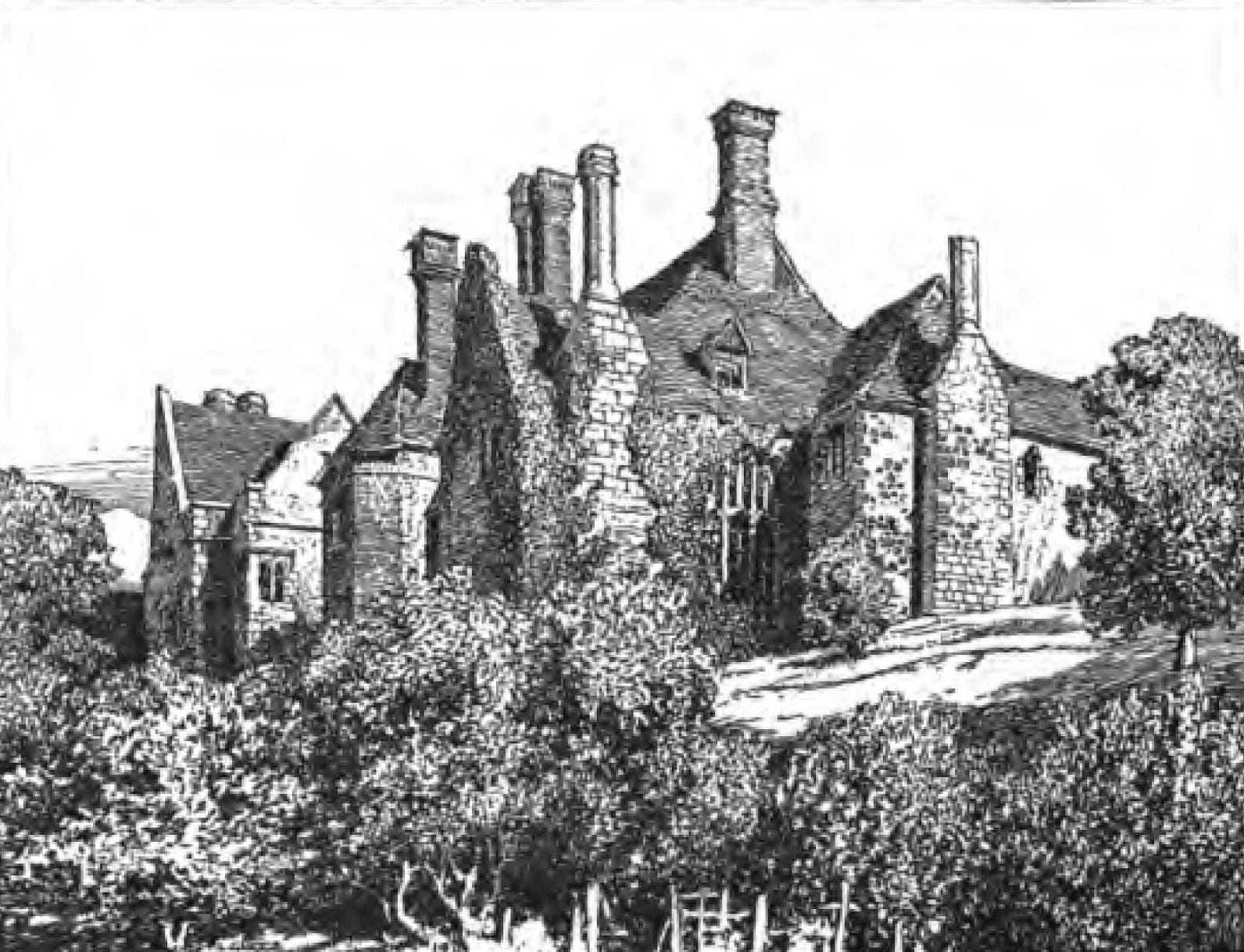
In 1898, Brede Place was a dilapidated structure veering toward ruin. A landmark that was desperately in need of renovation. It had been abandoned since the late 18th Century when it was taken over by Moreton Frewen – a member of the family line which had held the property since the 17th Century.
The manor had no indoor plumbing, and its interior was under constant assault by what one observer described as “chill, damp, and draughts.” But Frewen offered to rent it to Stephen and Cora Crane for mere pennies so that they could make a start at fixing it up.
The couple’s decision proved catastrophic for Stephen’s fast-deteriorating health. England’s chilly damp was not what any doctor would have ordered for advancing tuberculosis. Enduring this malady in a crumbling pile of stones was many degrees worse.
Yet Brede Place held other attractions for Stephen and Cora – who had lived as a married couple after fleeing the United States in 1897 to cover a war in Greece as journalists without ever tying the knot. Cora was still technically married to another man, a well-connected British officer named Donald William Stewart. In particular, their dire financial situation made even a damp and ancient pile of stones appealing.
* * * * *
The Ghost – written mostly by Stephen and Cora – was the centerpiece of the festivities in the final week of 1899. The striking presence of so many illustrious authors at the center of a game devised by the author of The Red Badge of Courage has made the episode a key passage in most Crane biographies.
The end of 1899 also was the final winter holiday season of Crane’s 28 years, and the party has been framed subsequently as a final torch of gaiety thrust into the oncoming darkness of his final illness.
In Stephen Crane: A Life of Fire, Paul Sorrentino sees the three-day gathering as a sign that “Crane never lost his sense of play,” even in a landscape of illness and debt. Paul Auster’s take in Burning Boy – a dazzling testament of imaginative sympathy with Stephen’s literary greatness – is that the party was “Crane’s last prank,” in which the author was “the guiding spirit and master of ceremonies for Carnival of Craziness.”
The abiding strangeness of The Ghost episode first washed over me as I worked in the archives of Columbia University a few years ago, examining the key primary source documents of Cora Crane’s adventures as a war correspondent in Greece in 1897.
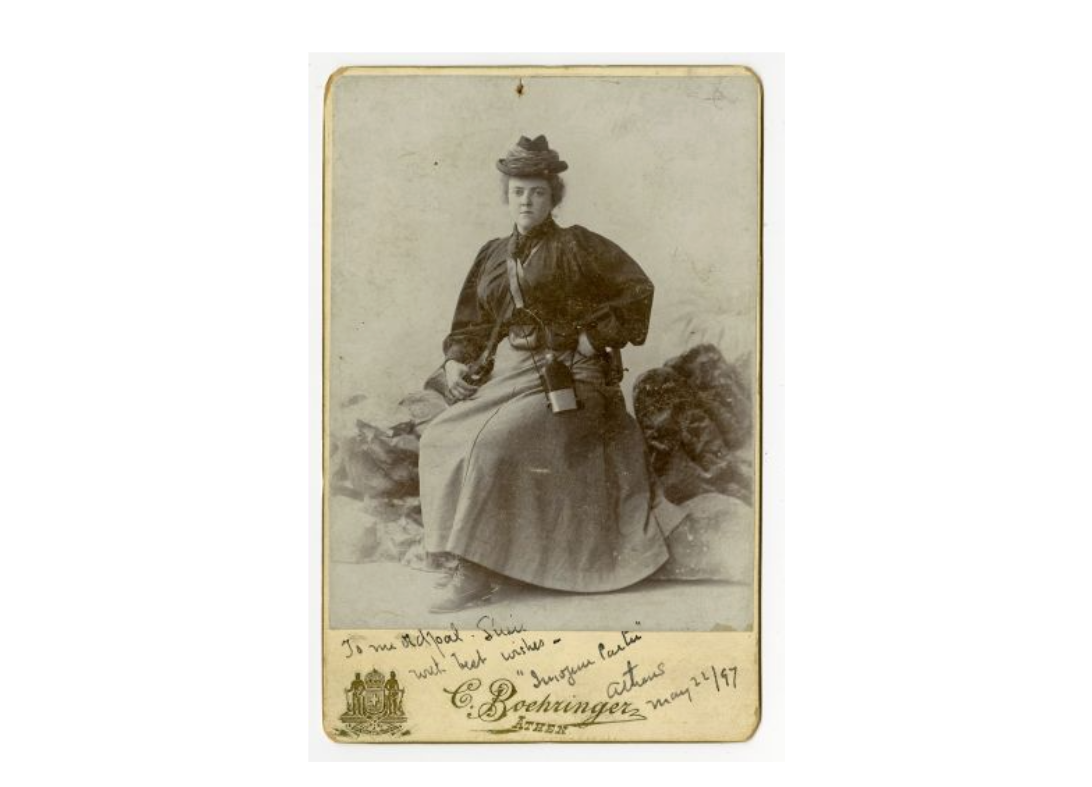
When Stephen Crane received an assignment to cover a war that Greece provoked with Turkey in early 1897 for the New York Journal, Cora ran away with him and wrangled a position as that paper’s “female war correspondent.”
Columbia’s Cora Crane collection has a number of treasures, including hastily-scribbled notes from a trip to the front lines where she came under fire at the end of the battle of Velestino in March 1897. But a program saved from the only performance of The Ghost is a show stopper.
The slim document is signed by Henry James, Joseph Conrad, H.G. Wells, and Stephen Crane himself. It also indicates that Wells’ second wife, Catherine Wells, served as “accompanist” on piano for the performance.
Holding such an object in your hands is the sort of thing that gets you hooked on finding treasures in archives. Prank or no, these prominent writers were all in proximity, and engaged in a shared activity. They passed a program around – either in the town hall, or back at drafty Brede Place after the show, or later – and signed it.
So, sure, The Ghost program is a small item. Yet it is an utterly fascinating object. A strange confluence of literary celebrity at the site of a holiday entertainment.
* * * * *
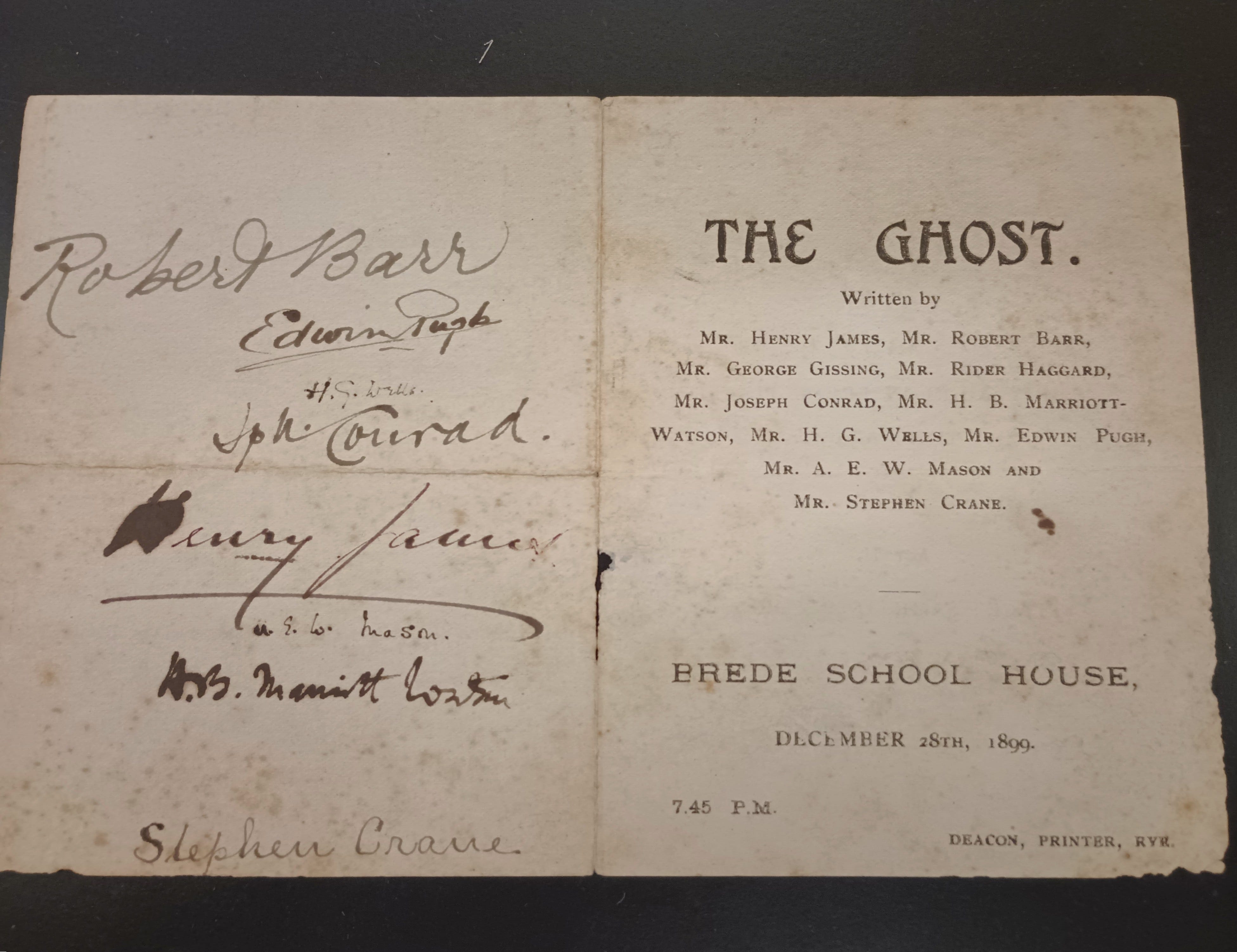
The program for The Ghost survived. The play in its entirety did not. Only fragments remain.
“The Ghost at Brede Place,” a 1952 article by John D. Gordan in the Bulletin of The New York Public Library, remains a succinct and authoritative version of these events. Many subsequent descriptions of the escapade have mined its engrossing details.
Gordan’s account strips much of the literary glamor from The Ghost. He replaces it with a tale of the sheer resilience, industry and grit required by those around Stephen – including Cora, Edith Ritchie (the niece of a family friend staying with the Cranes) and others – to transform a madcap and somewhat slapdash work into an actual show.
Even the program’s fascinating array of signatures does not withstand Gordan’s interrogation. He reports that as early as November, Stephen quipped in a letter that The Ghost was “awful rubbish,” and laid out his scheme to enlist others in the hijinks:
“[T]o make the thing historic, I have hit upon a plan of making the programmes choice by printing thereon as terrible list of authors of the comedy and to that end I have asked Henry James, Robert Barr, Joseph Conrad, A.E.W. Mason, H.G. Wells, Edwin Pugh, George Gissing, Rider Haggard and [H.B. Marriott] to write a mere word, – any word “it,” “they,” “you” – any word and thus identify themselves with this crime.
Sorrentino relies upon other sources to argue persuasively that the contributions of the other authors actually exceeded single words. (Conrad offered an apt epigram for a winter production: “This is a jolly cold world.”) But The Ghost was not an active collaboration as it is generally understood.
The play purported to have two acts, both set in Brede Place in the then-faraway year of 1950. A newspaper review published in early January 1900, and discovered by Gordan, asserts that The Ghost also had a “third” act – or perhaps a coda.
“The ever impractical Stephen and Cora convinced themselves that the twentieth century would be the dawn of a happier era in their lives,” argued Sorrentino.
The play itself is full of literary in-jokes and face pulling and blatant pilfering from Gilbert and Sullivan. (One character is named “Peter Quint Prodmore Moreau.”) The January 28, 1899 performance at Brede’s Town Hall was both well-attended and well-received.
Gordan also relates how arduous a task it was for the audience to make it to the town hall. One guest at the Cranes’ extended party, Charles Lewis Hind, observed that:
Of the play I have no recollection. The performance has been driven from my mind by the memory of the agony of getting to Brede village. It was a pouring wet night, with thunder and lightning. The omnibuses which transported us up the hill stuck in the miry roads. Again and again we had to alight and push, and each time we returned to our seats at the top (the American girls were inside) I remarked to my neighbor, H. G. Wells, that Brede village is not a suitable place for dramatic performances.
Gordan observes drily at the end of his piece that “[p]erhaps some day a manuscript of the Ghost will turn up among the papers of one of the collaborators. If the text has disappeared forever, we know enough about it to rest assured that we have lost nothing more than a curiosity. Yet any curiosity that involved such an array of talent is a ghost that can never quite be laid.”
* * * * *
While Gordan banishes The Ghost itself to some extent, multiple hauntings surrounding the work do linger on.
In the direct aftermath of the performance, the cast and guests at Brede Place navigated back through the muck to the dilapidated manse and continued the party. The late night revelries to celebrate a triumph upon the boards bled into the next evening, when a gala ball was held at the manor.
That night, Stephen’s flesh faltered at last despite the high spirits. He suffered a lung hemorrhage after the party wound down – a fact which he attempted to hide from both his guests and from Cora. When she discovered its extent, she prevailed upon H.G. Wells to pedal a bicycle at dawn in a cold drizzle to fetch a doctor eight miles away.
While the hemorrhage was not fatal, it kept Stephen in bed until after the New Year. It also proved to be a dire foretaste of occurrences to come. By May, even as spring came to the south of England, doctors insisted that Stephen leave Brede Place for a better climate.
Stephen and Cora crossed the English Channel on May 24, 1900. They reached Badenweiler by May 28. On June 5, Stephen Crane was dead.
* * * * *
Paul Auster paints the epic party at Brede Place which ended 1899 in the boldest possible colors: “A dying Puck pulls on his boots for a last romp in the woods.” He saw Stephen as a man slated for execution, who “looks at the firing squad lined up against him, calmly smokes his last cigarette, and then, rejecting the blindfold they offer him, laughs at his executioners as they lift their rifles and take aim.”
Crane was indeed brave. And wildly talented. And so impossibly young. He was only 28 years old when he passed away. Yet as I reflected on precisely where I first found the program, I found myself trying to see it all from Cora Crane’s viewpoint.
After all, I had discovered the program for The Ghost an hour or so after I examined notes taken by Cora pertaining to her experience of being caught in a battle in 1897:
Got horses – rode to Valestino [sic] – warned to turn back – but kept on. went on mountain Battery no 2 – Under actual fire. shells over head – got to Station for train – shell over my head five feet – just cought [sic] train. Which Turks shelled
Cora had run away from her night club and gambling den in Jacksonville – the Hotel de Dreme – to follow Stephen for a grand adventure and a life together. After a brief spell of domesticity following the couple’s arrival in England from Greece, however, life turned nightmarish.
Only a year after being in Greece with Cora, Stephen bolted across the Atlantic to cover the Spanish American War in April 1898. His dispatches are among the finest journalism written on that conflict. But the costs were immense.
In short, Stephen lost himself on purpose during and just after the war. He simply cut off communications with Cora. He was declared missing in September, and she wrote desperately to diplomats to try and find him. And when Stephen finally got back in touch in October, he was already growing sick. He was wracked first with tropical diseases, and then the tuberculosis which would kill him.
Stephen finally boarded a boat back to England on December 31, 1898 – a year before the Brede Place party. Yet the turn of the calendar page and Stephen’s return brought little relief: 1899 saw bitter battles with creditors and a churn of prose produced to bring in money to satisfy them.
At times, Cora must have measured the distance as I have just done. Yet her letters and other accounts radiate optimism and a can-do energy amidst the tumult in a drafty 14th Century manor.
Elizabeth Friedmann is the author of A Mannered Grace, the definitive biography of the poet and writer Laura (Riding) Jackson, and editor of The Laura (Riding) Jackson Reader. She has been working on a yet-to-appear account of Cora Crane’s life, and her deeply-researched observations helped shape Auster’s Burning Boy.
Friedmann says: “Cora was thrilled to have Crane back and in denial concerning his illness. Yes, he was in bad shape when he returned from Cuba, but she was certain she could nurse him back to health. He was happy being ‘Lord of the Manor’ and he loved parties as much as she did — or at least pretended to for her sake.”
Cora wrote a letter just after the party to Clara Frewen, the wife of their landlord. It shows the outward resilience and optimism that fueled her existence in 1900, as well as the deeper currents in her life that Friedmann has discovered in her research.
We also see another side of the party that spawned The Ghost. This is not Puck writing. Yet it seems to me that Cora puts as brave a face on these events as any condemned prisoner of fate might:
We had many disappointments at the dance on account of illness and the bad weather but forty eight people sat down to supper in the old kitchen under hams and puddings which hang from the ceiling. It was all most simple and I think you would have enjoyed seeing the old house lighted up.
Photo credits:
(1) Illustration of Brede Place by Frederick L Griggs from Highways and Byways in Sussex. (1907 / Public Domain)
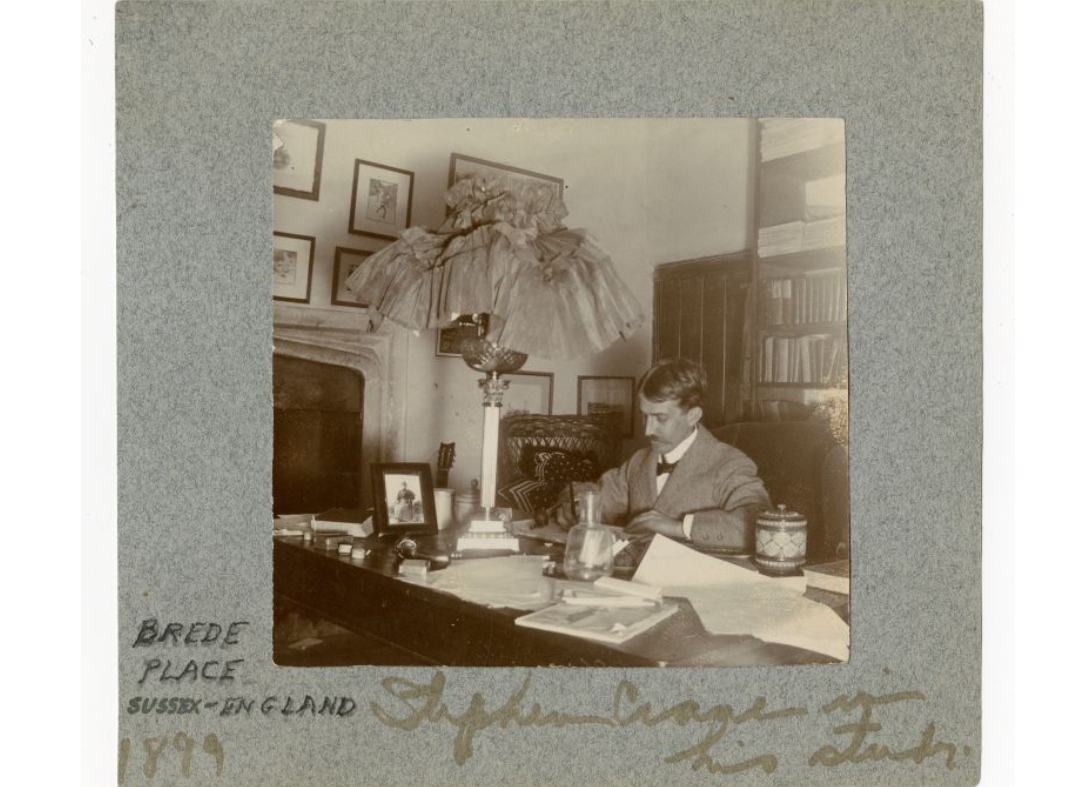
(2) Stephen Crane in his study at Brede Place in 1899. (Stephen Crane Collection/Syracuse University Library)
(3) Cora Crane as a war correspondent in Greece in 1897. (Stephen Crane Collection/Syracuse University Library)
(4) Cover and back page of the program for The Ghost, December 28, 1899 (Columbia University, Rare Book & Manuscript Library, Cora Crane papers, 1886-1910; Photo by the author.)
 | A guest post by
|
Loved this!
Also, Rich, I listened to the Congressman Davy soundtrack album on Monday and enjoyed it. Very impressive! I was going to message privately but others who see this comment can check it out, too!
wow, this is amazing!! i love it. thank you rich!