

ESSAY: Fall Term
Remember that every interpretation is an incorrect interpretation: A syllabus with excerpts from the readings.


Fall Term
A syllabus with excerpts from the readings
Professor N. Rombes
Fiction (F)
Poetry (P)
Nonfiction (NF)
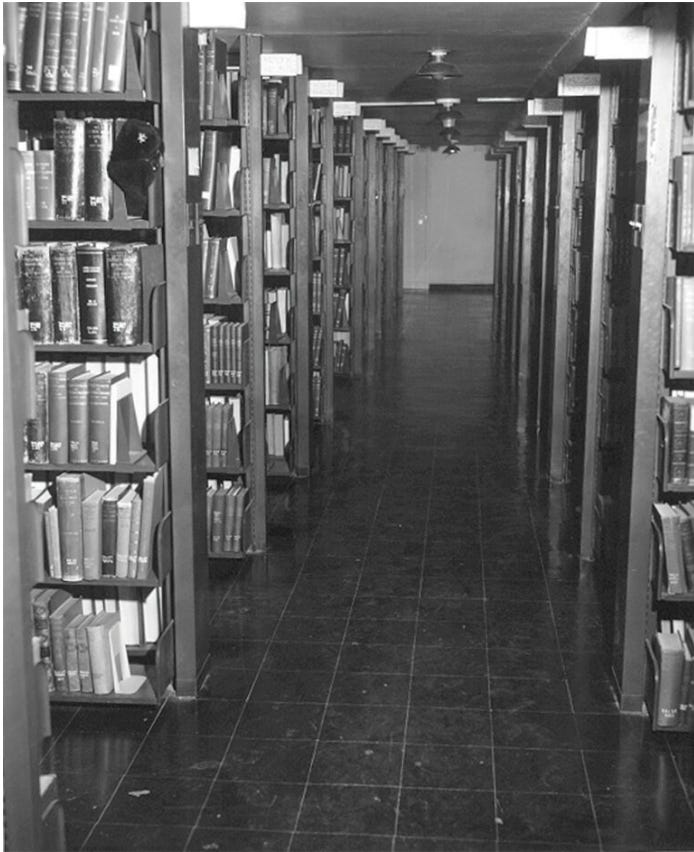
If you can’t afford the books, full photocopies will be made available for you to retrieve at locker xxx at drop point yyyyy. Read each book from beginning to end. Class meets at the “old” library in the stacks, basement level 13. Bring lanterns. Class during week 4 is an overnight. Bring sleeping bags. Your professor is not your counselor. You are permitted two objections per class. Smoking is permitted beneath the window in the boiler room at the east end of the stacks. Basement level stacks 15-17 are forbidden. Level 13 is underpopulated with books and shelves and spans three acres. Bring a bike if you wish. There is no natural light. There are working vending machines. If you are allergic to solvents containing tetrahydrofuran bring a mask and rubber gloves. Bring your own water.
There are no office hours. During discussion modulate your voice volume as the stacks echo. The elevator is non-functional. Be kind to each other. Remember that every interpretation is an incorrect interpretation. Including your professor’s. Think of me as a trail guide. If I point out a pitfall and you choose to ignore my warning you will bear the consequences. The dark places our readings will take us into can only be illuminated by the dedication of your thought. Bring sound-cancelling earbuds/headphones for the periodic flushing of the boiler. I cannot dispense ibuprofen. There is no department chair. The going price for Richard Meltzer’s Post-Rock Cultural Pluralism in America (1649-1980) (week 2) is 250.00. At our first meeting I’ll provide you with vouchers for this book. Bring sunglasses for the orange globe that illuminates our area of the stacks for one hour each day, randomly.
Leave your cares about your family and your friends at the iron door of the stacks. As that man once said, “the earth belongs in usufruct to the living.” You—we—are the only living in this class. The world belongs to us.

Week 1
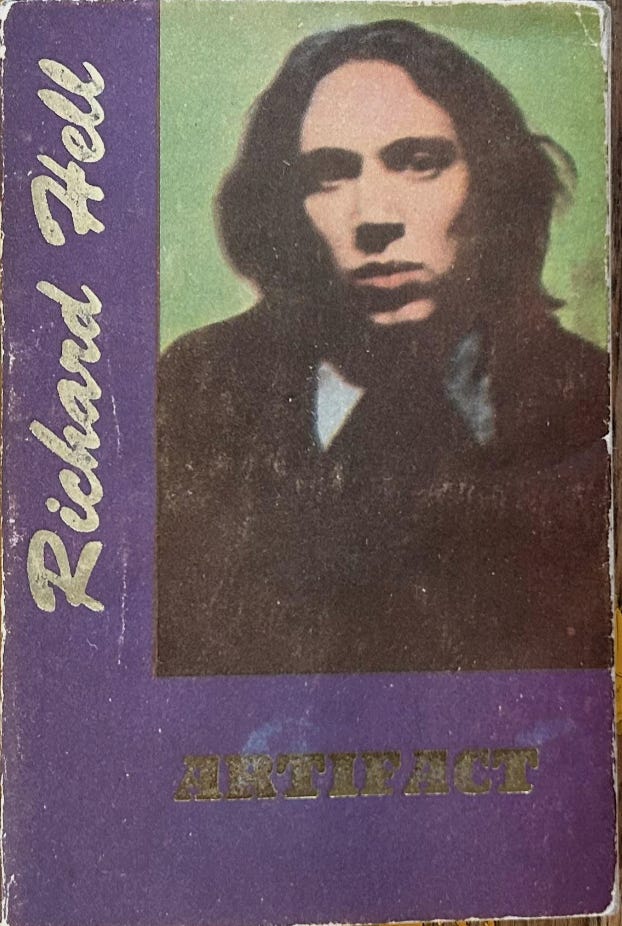
Richard Hell will detour your thoughts in Artifact: Notebooks from Hell, 1974-80. Hanuman Books, 1992 (F). When he asks “Is my dream just the dream of all celebrities?—The wish to have a stranger say ‘I love you’?” is he really asking or telling you something you already know: that you desire to be seen, to be recognized, to be acknowledged, to be, at last, affirmed?
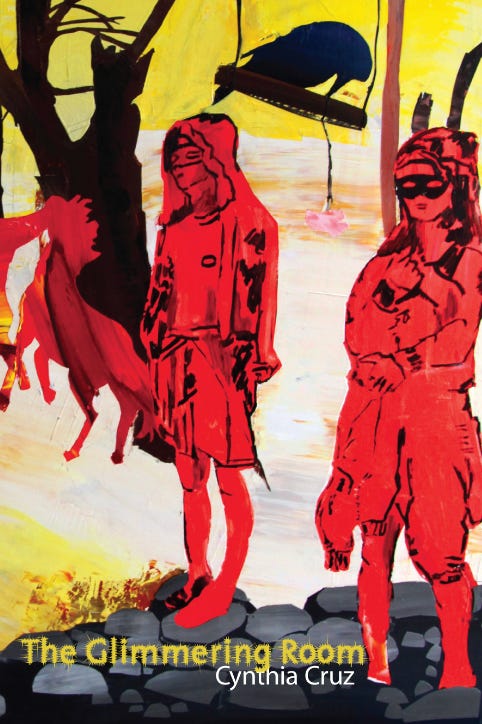
Cynthia Cruz’s The Glimmering Room. Four Way Books, 2012 (P) is a book of spells disguised as a book of poems. From “Strange Gospels”:
Eleven-year-old girls on Polk
Street in heels and white blonde wigs.
Silver beads and burns.
Death and her sons
Coming on to me like bullies.
Oh God of needles, God of
Hand jobs, blow jobs, pearly
Pistoned handguns
I am diseased with this
Recurring dream that is
My life.
We will take turns reading these aloud, quietly so as not to stir the warm, sleeping thing that is the true audience for these poems, that little sliver of thought that you don’t want to acknowledge but that you will be forced to via The Glimmering Room. Because of the dangers involved here, we will remove our class for this book deeper into the stacks where our voices are less likely to be heard. However, six years ago a student wandered far too deep and noclipped into, well. So: no wandering!
Week 2
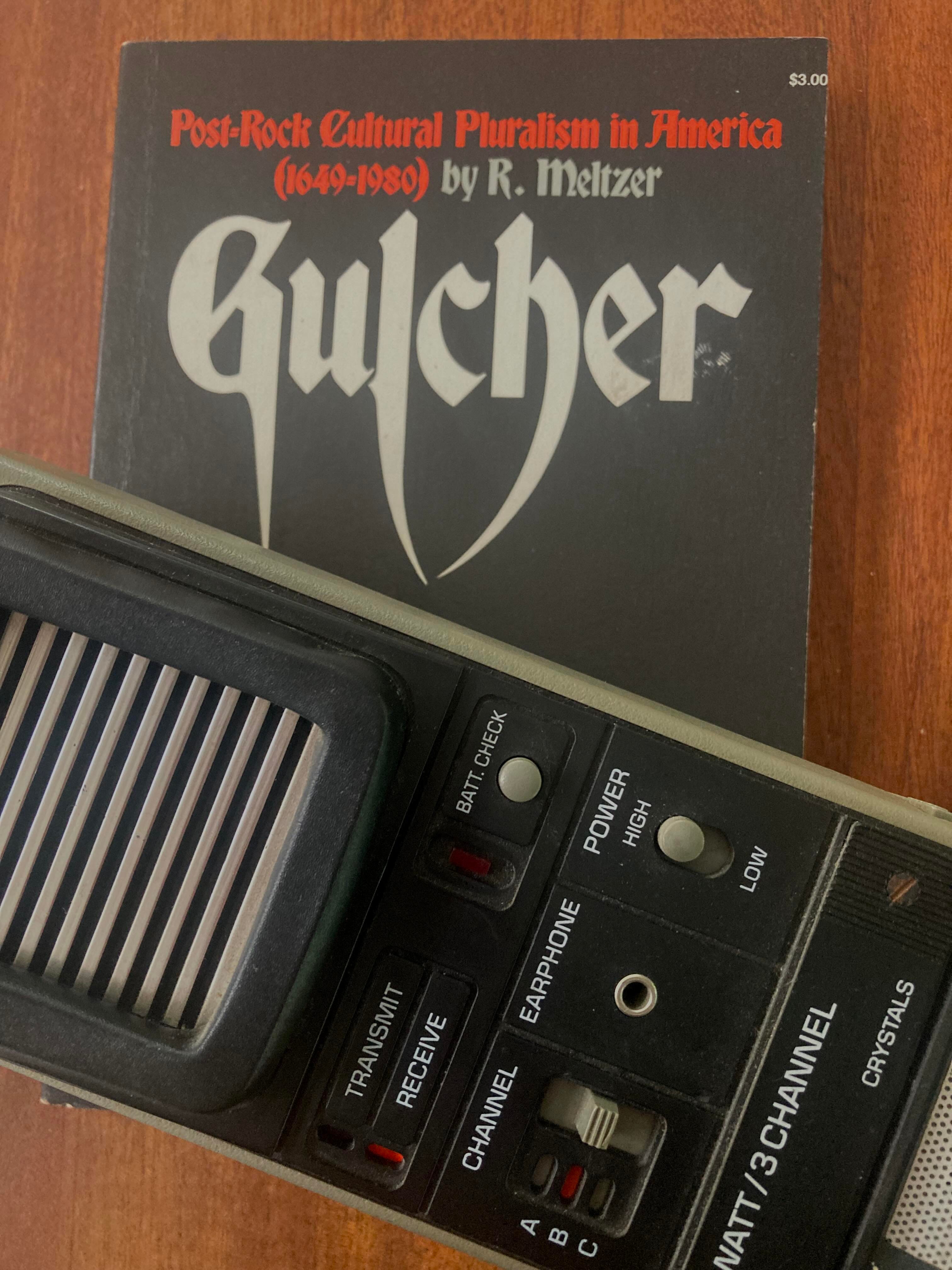
This week begins with Post-Rock Cultural Pluralism in America (1649-1980). Straight Arrow Books, 1972 by Richard Meltzer (NF): “It’s easy with a pack of Camels, it’s easy to tell which side is the front and which is the back. The front is the side with the camel’s back on it . . . and the back is the side with the buildings in town where people live. . . . But on the pack of Lucky Strikes both sides are identical.”
This reading requires smoking. Obviously. We’ll pass around a Camel. You don’t have to inhale. Remember: 1972 was either the best of years (the hangover of the sixties hadn’t yet kicked in, and the seventies hadn’t really begun) or the worst of years (even the dimmest amongst us knew the end was near) and so we need to handle this one with care, like our solitary cigarette.
In her essay “Beginning to See the Light,” which appeared in The Village Voice 1977, Ellen Willis embraces a verboten genre, at least for women: punk rock, in its sneering, misogynistic first wave. “It [‘Bodies’ by the Sex Pistols] was an outrageous song, yet I could not dismiss
it with outrage. The extremity of its disgust forced me to admit that I was no stranger to such feelings,” she writes, and “timid music made me feel timid, whatever its ostensible politics.”
For this reading our companion will be Never Mind the Bollocks, Here’s the Sex Pistols. Your professor will provide a turntable, speakers, and 700-feet of extension cord, as the closest electrical outlet is on basement level 7. When the record approaches the song in question, “Bodies” (side two, track three) your professor will leave the stacks area. A designated student will, in consultation with the class, determine how many repeat listens the song merits. Afterwards, the student will signal for the professor’s return, via a communications system to be introduced during the first class session. This is a high-stakes week; Meltzer and Willis are major figures who have not reached major status. Willis—although more well-known that Meltzer—has been misread as a “cultural critic,” while Meltzer, frankly, has not been read at all. This class is not about hagiography. Collectively, we might conclude that Meltzer and Willis are not major figures after all. We might decide to bury them further in the folds of history.
Week 3

Linda Boström Knausgård, Welcome to America. World Editions, 2019. (F)
“Darkness was everywhere. The darkness smelled. It smelled of fright and something
sickly. Darkness it was that rushed from the tap and filled up the bath. I washed my
hair in darkness, my body, my entire being. I ate of the darkness, and was stained by it
inside.”
This is a sentence from Welcome to America. In its melodrama, in its immersive feeling we ask ourselves: am I no longer permitted to feel as truly and deeply as Knausgård’s narrator? Must I abandon feeling at the gates of cynicism? In roaming through this slim book we need to be careful and watch out for the small hatch-door traps hidden within her prose.
Olena Kalytiak Davis, shattered sonnets love cards and other off and back handed importunities. Tin House, 2003. (P)
Reader unmov’d and Reader unshaken, Reader unseduc’d
and unterrified, through the long-loud and the sweet-still
I creep toward you, Toward you, I thistle and climb.
I crawl, Reader, servile and cervine, through this blank
season
These are lines from “sweet readers, flannelled and tulled,” and they will be our entry point into Davis’s work. We’ll read these poems in reverse order. It’s important that you not learn anything about the author prior to our reading. This session will involve gardening. This session will involve thinking about poetry with our bare hands.
Week 4
Gerald Langford, Faulkner’s Revision of Absalom, Absalom! A Collation of the Manuscript and the Published Book. University of Texas Press, 1971. (NF)
The Faulkner reading presents its own set of problems. Ambiance will be important for this class session, which is why I have invited Kane Pixels, creator of The Backrooms, to design our space in the stacks for Week 4. “The Absalom Effect,” as he calls it, will reconfigure level 13 via a vectoring process that enacts a literal geography of the stacks, in all its varied meanings. If you suffer from vertigo, Mad de Barquement Syndrome, or Ménière’s Disease, you are strongly cautioned against attending this week’s class. As Central Administration did not sign off on Mr. Pixels, this syllabus—a public document—does not go into detail about the nature of his project or its potential risks to you. In fact, the sentence “[t]he Faulkner reading presents its own set of problems” is a gross euphemism. Here is a brief example from the Langford book:
Faulkner’s original manuscript draft: “with impunity and he discarded or sold or even murdered her when she became worn out, with impunity, yes:”
Faulkner’s revision for the book: “with more impunity than he would dare to use an animal, heifer or mare, and then discarded or sold or even murdered when worn out or when her keep and her price no longer balanced. Yes:”
Mariana Enriquez, “Black Eyes,” from A Sunny Place for Shady People. Granta, 2024. (F)
A key sentence from the story: “Chapa got out to ring the bell, and stopped short: the gate was open, but it was a narrow opening. It was a deliberate invitation. A signal.”
We’ll pair this reading with clips from The Grandmother and Lost Highway by a director Enriquez admires, David Lynch. The Grandmother will be presented in 16mm. What is the role of signals in art? What are the consequences of misreading such signals? Is there a danger in opening up ourselves to them? Having been infected by signals, is there an antidote? Is there an antidote to art, or is art itself the antidote?
Week 5
From Louise Glück’s poem “Mariana,” in Meadowlands. Ecco, 1996 (P):
You took me to a place
where I could see the evil in my character
and left me there.
Glück’s persistent use of the accusatory second person forces us into an awkward position, an awkwardness we will need to confront openly and honestly during this class session. A counselor will be brought in. For this session you’ll need to sign an NDA. You’ll also need to provide a hair sample. Our objectives for this class session are esoteric.
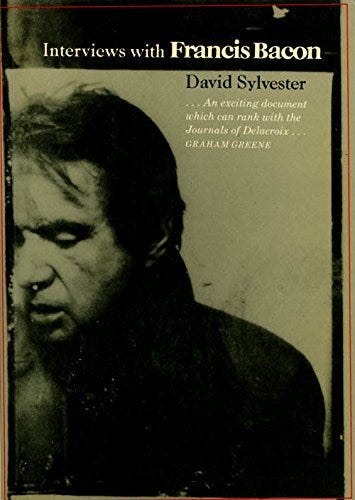
David Sylvester, Interviews with Francis Bacon. Thames & Hudson, 1980. (NF)
DS: What you seem to say is that in your own case surprise takes over from intention
quite early on.
FB: You see, one has an intention, but what really happens comes about in
working—that’s the reason it’s so hard to talk about it—it actually does come about
in the working. And the way it works is really by the things that happen. In working
you are really following this kind of cloud of sensation in yourself, but you don’t know
what it really is. And it’s called instinct.
An original Francis Bacon painting—Sphinx III—is on loan from the Hirshorne and will be made available for our viewing in the underground stacks, level 54. Bring a sweater. We will pick up and run with Bacon’s phrase “cloud of sensation.” We will endeavor to push to the limits of our own horizons. Each student is permitted five solitary minutes in front of the Bacon painting.
Week 6

Constance Debré, in Love Me Tender. semiotext(e), 2022 (NF), writes:
“They tell me not to publish the book, they tell me not to talk about girls, they tell me
not to talk about fucking, they tell me I mustn’t do anything to hurt Laurent, they tell
me I mustn’t shock the judges, they tell me to give myself a pen name . . .”
This week features Debré and Levis, an unlikely pairing at first glance. Can we force these two authors (one dead, one living) into conversation with each other? As Love Me Tender is a Universally Restricted Book (URB) we will need to read it in paraphrase form. As you know, URBs are forbidden; technically they are not even supposed to exist. The word-limit on reproduction is 50 words, per the excerpt above. We will devote our energy to these 50 words and pretty much ignore the rest of the book, which is only legally available as a poor paraphrase.
Larry Levis, Winter Stars. University of Pittsburgh Press, 1985, (P):
My father once broke a man’s hand
Over the exhaust pipe of a John Deere tractor. The man,
Rubén Vasquez, wanted to kill his own father
With a sharpened fruit knife, & he held
The curved tip of it, lightly, between his first
Two fingers, so it could slash
Horizontally, & with surprising grace,
Across a throat.
This is from the poem which titles the collection. Why were some of Levis’s best books published by the University of Pittsburgh Press? This will be our entry point question into his work. What are the particular geographies of Pittsburgh that allow his poems to flourish there? We know that the Pitt Poetry Series was founded in 1968. We know that Levis died in 1996 at age 49. We know that he used the phrase “widening spell” to describe the exploratory experience of writing poems, especially poems about nothing. How might we enter into our own widening spells without hurting others? How might our truths be everyone’s truths without cancelling out those other truths?
Week 8
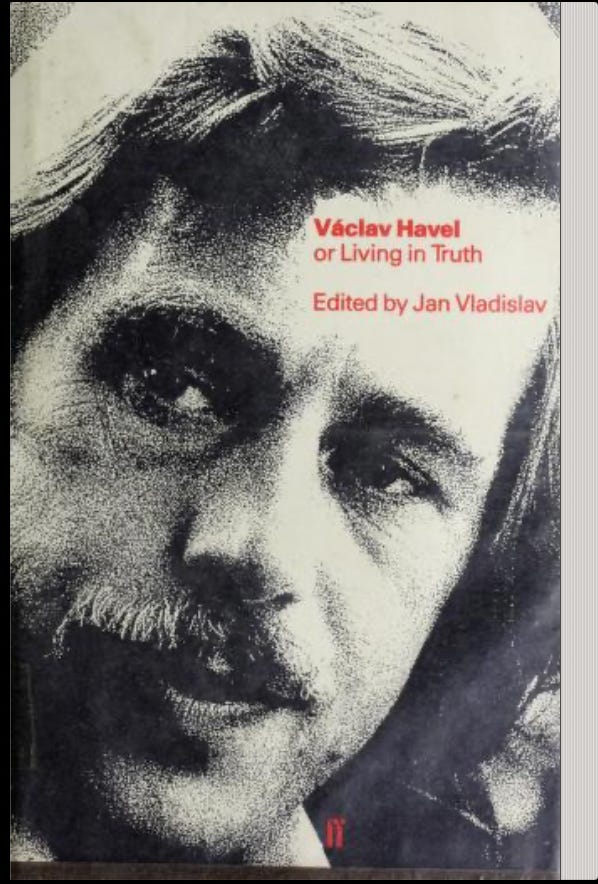
Václav Havel, Living in Truth. Faber and Faber, 1986. (NF).
Here is where we’ll end:
“The fact that human beings have created, and daily create, this [oppressive]
self-directed system through which they divest themselves of their innermost
identity, is not therefore the result of some incomprehensible misunderstanding
of history, nor is it history somehow gone off its rails. Neither is it the product
of some diabolical higher will which has decided, for reasons unknown, to torment
a portion of humanity in this way. It can happen and did happen only because there
is obviously in modern humanity a certain tendency towards the creation, or at
least the toleration, of such a system. There is obviously something in human beings
which responds to this system . . . something within them that paralyzes every effort
of their better selves to revolt. Human beings are compelled to live within a lie, but
they can be compelled to do so only because they are in fact capable of living this
way.”
And
“For the real question is whether the brighter future is really always so distant. What if, on the contrary, it has been here for a long time already, and only our own blindness and weakness has prevented us from seeing it around us and within us, and kept us from developing it.”
These, from “The Power of the Powerless,” originally appeared in 1978 as a samizdat publication. The more it was repressed by the Czech authorities, the more it spread. In December 1989 Havel was elected president of the Czech Republic. One of the first people to interview him after this was Lou Reed, in 1990. “Underground music, in particular one record by a band called Velvet Underground, played a rather significant role in the development of our country,” Havel has said.
For this class session we will go outside.
Into the sunshine.
We will shed our worst selves and lean deeply and lovingly into what we have unlearned.
 | A guest post by
|
perfect brotherhood syllabus, im an eager student
I want this class to be real so bad