

ESSAY: Let Me Be Your Daddy
How a 1986 Erotic Romance Allowed Me to Embrace My Own Voice

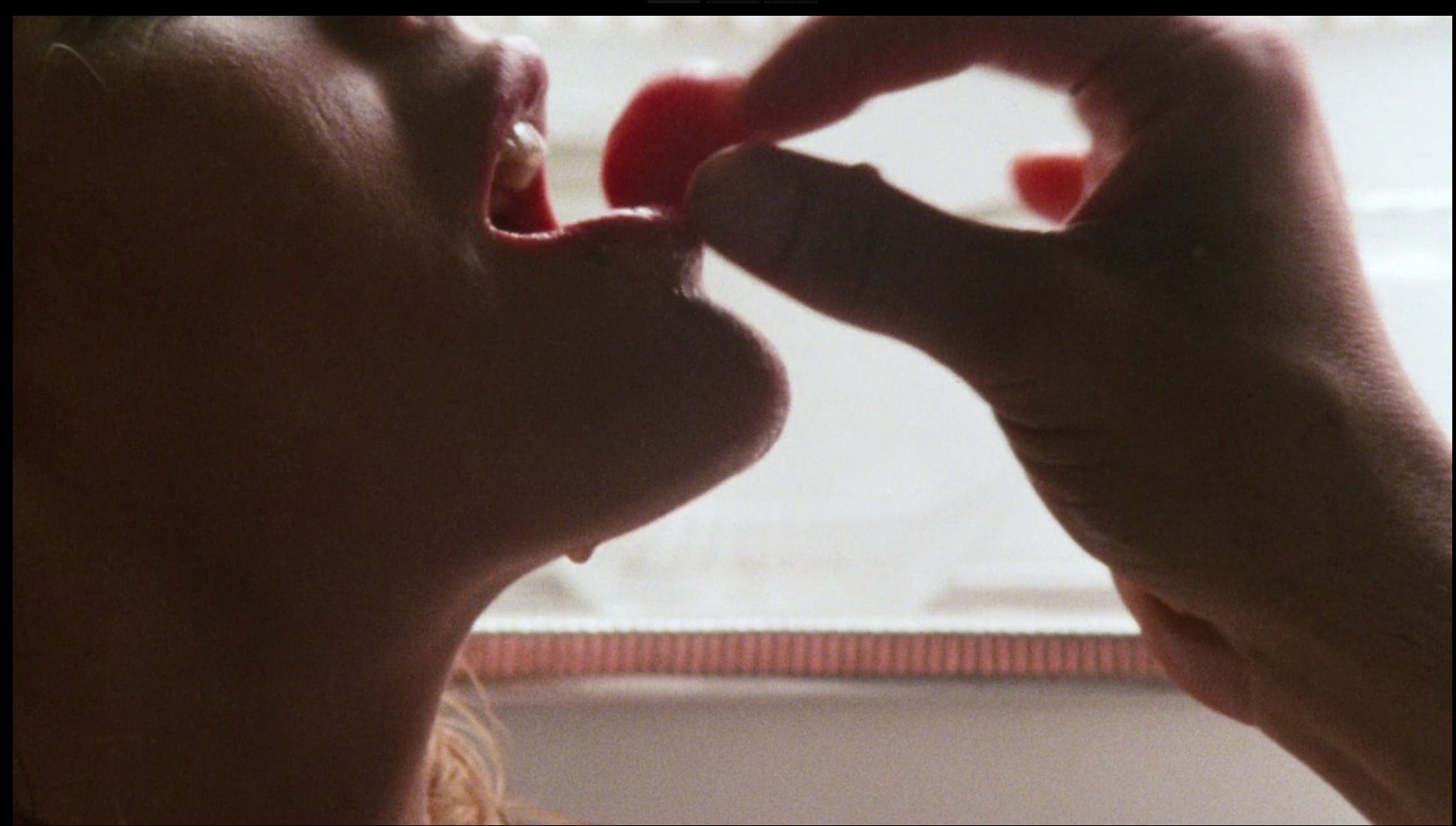
When the cherries enter her mouth, she trembles.
Maraschinos: wet, gelatinous. Preserved in a brine and soaked through with sugar, the kind of false, electric red that reminds me of flushed cheeks, a freshly bruised knee, the cheap drugstore nail polish I painted on myself at thirteen. The fruit arrives on a spoon without the benefit of visual cues; she keeps her eyes closed, her anticipation telegraphed in the tilt of her chin, the arch of her neck, body lurching forward, attempting to close the gap between ignorance and awareness. She extends her tongue, lips already slick with the eggs and olives that have come before.
I've cast myself in the role of voyeur, watching Kim Basinger's perfect bone structure obliterate the television haphazardly propped on a plastic storage container, a makeshift wardrobe with three flimsy drawers. I recline in bed, a cat that does not belong to me circling my feet, the noise from her vocal chords less a purr and more the thrumming of an overheated engine. I think she is jealous; I think she wants me to leave. My former partner and I are deep into a viewing of 9 ½ Weeks (Adrian Lyne; 1986), which follows the boundary-testing relationship between a Wall Street broker and art gallery curator. But no amount of heaving or moaning or sheer silk blouses outlined against erect nipples can inspire us to turn away from the soft haze of 35mm film and toward each other. No. Our eyes remain locked on the screen, waiting for the few threads of tenderness between the movie’s characters to implode.
We have a mission: Compare and contrast this movie with last year’s Babygirl, written, directed, and produced by Halina Reijn.
Earlier, at dinner, the sour pull of a lemon drop in my throat, I tried to express the oceanic lack I experienced while Nicole Kidman and Harris Dickinson performed mild temper tantrums against the ominous tension of a score highlighted by waltzes, animalistic beats, and operatic booms.
“It was too . . . surface?” I said, cringing at my own weak language and lack of strong argument.
Other thoughts: And, is it really BDSM? Or only an impression of an impression of BDSM, overheard indirectly and at a whisper? I found the chemistry utterly lacking between Kidman and Dickinson, whose performance as Bill in A Murder at the End of the World left me with a kind of low ache that made me a devotee to his performances for life. And what of the two brief mentions of her childhood in a cult? If I were to write that into a novel, I would receive a tidy little margin note that read: FLESH THIS OUT. I liked Dickinson’s shirtless dance because he transformed such a meme-ready, performative moment into a sequence of movements so insular, so not full of bravado, but rather a genuine, self-satisfying sexiness. I liked the inclusion of INXS. I liked the milk.
Otherwise, I hated it.
Basically, I wanted more.
“I need to show you 9 ½ weeks,” I said at dinner, licking the sugar from the rim of my glass, trying and failing to unleash a few hardened crystals. “It’s been a handful of years. I need to see if it lives up to my memory.”
“Finally,” my ex said. “You’ve been talking about it forever.”
*
Thus, my rapt attention to the mechanics of this 80s erotic romance, an attempt to coalesce my musings into a collegiate-debate level of critical analysis, frustrated to a neurotic degree anytime I can’t properly articulate my thoughts on a piece of art. But my scholarly mindset comes to an abrupt halt when the aforementioned scene of culinary seduction rips a seam, hot and screaming, through my concentration.
“Is this why you like blindfolds?” my ex says, nudging me with amusement. “Why you want me to feed you?”
Yes, it’s becoming absurdly obvious how much this movie—watched repeatedly in my adolescence, probably matinee showings on HBO or Starz in my parents’ suburban home—has imprinted on my psyche. The psychology is grossly simplistic. But this revelation isn’t what finally pulls me out of the trance created by so many closeup shots of Basinger’s face as she and Mickey Rourke sit on the kitchen floor, turning the refrigerator into foreplay.
While watching this scene, I experience a minor breakthrough, a moment of self-awareness so intense it causes about 15 seconds of dissociation, that surreal and unsettling sensation of reality slipping away, its veil loosening, a humming in the ears, the body and all of its trappings suddenly a strangely inanimate object viewed from some other plane. This epiphany relates to my life as a writer and how I've been fighting against—trying to resist and alter—my own voice and stylistic preferences over the last several months.
Lately, I've become obsessed with concision. In the margins of my printed drafts: Athletic prose! Less description! Lean! Clean! Keep it tight! Calls to action reminiscent of a YouTube Pilates instructor or an infomercial at two AM replete with slapstick comedy, a woman dropping a half-peeled boiled egg that bounces on the floor as the screen goes black and white, freeze-framing her shocked face.
I ruminate on a sentence in a Sally Rooney novel, a description (really, a mention) of a salad bowl, convincing myself it's emblematic of my lack of talent. I've been revisiting my father's musty, spine-cracked copy of The Collected Short Stories of Ernest Hemingway. If you've ever needed proof that style can influence content, here it is: I become tormented by the urge to write sentences about men and fishing and logging towns and mountains and glasses of beer. Lots of dialogue. Lots of He walked down to the lake and drank several beers and The fields were yellow and unmoved by wind and The girl looked at the man before standing to take off her coat. He picked up the soap and scrubbed his face. He gave himself a close shave before readying for dinner. It was nicer here, he thought, than in Mallorca.
You get the point.
In comparison, my sentences are gluttonous, rambling, repetitive, filled with em dashes and compound adjectives. I keep thinking of James Baldwin urging us to “write a sentence as clean as a bone” in the The Paris Review. In that same interview in the spring of 1984, he also said that the writing process requires “a certain amount of recklessness.”
And, here, in 9 ½ Weeks, I encounter all things impulsive and heedless, a restraint that ultimately allows for succumbing to instinct and desire. I recognize elements of my own style: excess, texture, repetition, chaos, specificity. The mess of a dinner party overflowing with drinks, people reaching over each other, interrupting, too loud and too warm in an apartment saturated with art prints and fabrics. The NYC streets flooded with people elbowing, rushing, getting lost in the anonymity of a crowd. All the shoulder pads and pantyhose and hair. The camera zooming, focal length decreased, moving in close, close, closer.
How might I arrive at my own version of precision without sacrificing my feral appetite to go deeper, to sink my fangs into the subject matter and swallow it whole?
*
Perhaps one of my most common notes while providing editorial feedback for other writers encourages them to be more specific. (Also, to lean into the weird.) I reference Susan Sontag and quote Anne Lamott: “There is ecstasy in paying attention.” Often, those new to the craft of writing seem stuck on the idea that keeping their prose generic—light on specifics; on actually naming emotions and objects—will help readers to more easily insert themselves into the narrative and connect with the story. But, I argue that the opposite is often true for the same reason cliches fail to capture our attention and move us. They are vague, shallow, washed out, and toothless—so familiar they lose all meaning and ability to evoke.
Alternately, nuance and specificity draw readers to the page, allowing them to excavate memories, unearth baggage, and make their own associations, connections, and conclusions. Your character chain smoking a pack of KOOLs outside a roller rink in the summer of 1972 after a breakup will remind your reader of getting high in the parking lot after a session of cosmic bowling, during which they tried to kiss their best friend while black lights turned everything to purple fuzz. You have to trust your own vision and respect your characters and their stories enough to remain true to the particulars of your work, which is also a way of respecting your readers.
So, if you're inclined to poetics, if you love a whole chapter of lists, if you want to format three pages as a screenplay, if you need to hone in on minute details and tangle us up in stream of consciousness, do it. Ultimately, I suppose my love of specificity comes down to my belief that voice is everything, and every single experience and thought you've ever had will ultimately show up on the page. Even if your style is light on details, even if you bring a sort of “talking heads in a vacuum” vibe to the party, the few specifics you do choose will ultimately tell us everything we need to know.
*
The cat circles and purrs while I stare at the screen, and the night comes to its eventual close. What began as a desire to perform an exercise in critical analysis of two art projects transforms into a moment of relearning how to trust myself, which isn't so dissimilar from the decision Kim Basinger makes at the conclusion of the film. Or, the decision I recently made in my own personal life–to respect myself enough to leave a person who couldn’t stop hurting me.
What I know about myself is this: As a writer and reader, I want to open all the hungry mouths. I want to explore the exact texture and color and taste of every food held up to a character's trembling lips and groping tongue.
I want to let the syrup drip. Make a mess of the kitchen floor.
 | A guest post by
|
🍒🍒🍒
THOSE LAST LINES. Goosebumps, girl <3