

REVIEW: A Completely Embarrassing Problem
Sam Franzini on Brian Barth’s “Front Street”

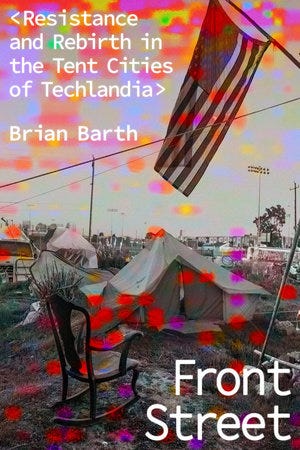
There really is no reason, for any healthy society, to have people sleeping out on the street. A country as wealthy and powerful as the United States (and for how much we like to tout our wealth and power) should not let its citizens rest on a park bench, under a dirty blanket, or on the concrete. And if such a gross display of negligence were to happen, the government should definitely not spend millions of dollars irritating, demonizing, and using every bit of their force to trash the scraps of their settlements and push them forward to oblivion, danger, and another unstable place to be. Good thing that’s not happening here, right?
In any city, it’s easy to look away from people sitting on the ground, dirty and disgruntled; better ignore than engage. I’ve done it many times, robbing them of their humanity, devaluing my own, for the sake of moving forward, because on the occasion I do look at them and think about them too much, I get sad, start imagining the concrete on my back, the smell that would start to accumulate. And my imagined reality is too painful, disregarding their actual reality. I couldn’t look away reading Front Street (Astra House, 2025), Brian Barth’s empathetic and urgent first book; it swiveled my head fiercely not unlike Sam Niell did to Laura Dern in the classic gif from Jurassic Park. LOOK! Barth says, not unkindly, but forcefully.
Barth’s narration—spent in homeless camps infused with his personal struggles, dating life and journalistic foibles—is quite charming. Funnily enough, he begins the book meeting Kent, the leader of Wolfe Camp, in “the worst year of my life.” Well, try being the other guy… one thinks. He is not a researcher nor a memoirist nor a political commentator, but a person in flux, a journey he describes as going “from journalist to friend of the unhoused” through his years of reporting on and living with camps. But he knows he’s not the main character. By letting its subjects do the talking, Front Street reads like a New Yorker longread; it’s a journalistic triumph that should be required reading for anyone who thinks of running for public office.
That the internet rewards extreme viewpoints means people naively discuss homeless people in one of two ways—innocents struck by bad luck or irritating nuisances. New York City Michael Jackson impersonator Jordan Neely, who was strangled to death, was either “non-human and disposable as an unhoused Black man,” or “a psychopath who terrorized subway passengers.” Daniel Penny, his killer who was eventually acquitted, is either a “Subway Superman” or a “racist, classist, ableist murderer.” Leftists say he should be in prison. JD Vance invited him to a football game.
Barth rejects both of these narratives. Homeless people contain multitudes—just like us, can you believe it?—and he presents them in lights both flattering and not. Some “have the personalities of rock stars; others have a refined literary sensibility; many are folks you’d want to kick back and have a beer with,” but they also “have a propensity to lie, steal, talk too much, behave irrationally, and throw their trash on the ground… Most I’ve known are unreliable, disorganized, and inept at follow-through.” They can be difficult, and “difficult people don’t tend to inspire others to be kind and giving towards them.” His is not a rosy view—by spending time with them and their erratic behaviors, he knows it’s worthless to ascribe a certain moral superiority just because they’ve been through a hard time—again, they’re just like us—and so he meets them where they’re at, warts and all. His pragmatism is refreshing and provocative. (Though at times, he resorts to Millennialisms like the Facebook Mom-esque Trump moniker “the Orange-Faced One,” or when he says a group of rallying homeless people fill the Columbia University lobby “with their paradigm-shattering presence,” which eschews clarity for a heroic image. Tiny also delivers a “paradigm-shifting soliloquy” ten pages earlier, which to me simply means it was a good speech.)
The friends he has made in the camps—and it does seem, through his longstanding commitment to telling their unadulterated stories, they have become friends—are the stars of the show, the ones who lead Barth to understanding, humility, and sympathy. Tiny is the most memorable of the bunch; a petite blonde woman who loves cheeky wordplay (“gentrifuckation”; “crapitalist”; “CON-sumer”) she is a founder of POOR Magazine, POOR Press, a host of Poor People’s Radio, the author of a memoir titled Criminal of Poverty and a “poverty scholar” who teaches classes about the practicalities of surviving the streets. She is a representation of homelessness that liberals favor since she has weathered the storm and used nonviolent tactics (i.e. media) to disseminate her ideas. She is invited to participate in Talks at Google, passing herself off as “palatable” as a Trojan Horse.
“No matter how many times you did a $200,000 study about homelessness and poverty, it did not give us a home,” she told the crowd. “And no matter how many times you put us in jail for being homeless, it did not make us homeful. And so actually what we need to do is start recognizing that folks in poverty have the knowledge to solve our own problems. Because otherwise you’re just talking about us without us.”
It didn’t go over well. She was, in the eyes of the Googlers, too revolutionary, and many stood up to leave by the time she got around to discussing reparations. “How did this woman get through the cracks?” a marketing director wondered. Her speech was not posted on the official Talks at Google YouTube Channel, some of whose 2.4 million subscribers could have benefitted from her perspective. We want you to be homeless, but not too homeless. You can be angry, but not too angry. You can ask for stuff, but not from us.
It’s funny—implicit in Barth’s task of living amongst and writing about homelessness is the idea that he is a Good Person. He has done more than any of us will do for their struggle, and thus should be praised. Tiny pushes back on this in fascinating ways. She excoriates him for his “byline privilege” (“I said I looked forward very much to learning what that meant,” Barth responds) and is not keen on his well-meaning idea to host people from the encampments on his upcoming book tour so that they can recount their own experiences. “That’s more exploitation,” Tiny says. “We don’t give a fuck about telling our story over and over again. What for? So that you could sell more books? No. Uh-uh. Fuck that.”
Barth is reasonably taken aback. “I know you’re trying to move with a loving heart,” she concedes, but “intellectual property is the only property us poor people have.” It’s a good point. Even though he’s doing it with the best intentions, Barth is profiting off Tiny and others’ stories, getting rewarded with a book deal and glitzy articles in Mother Jones and The Guardian. Reading the synopsis for this book on paper, a cynical reader could say he’s quite removed from the situation. He has a bed to go home to. Tiny doesn’t.
And this strange uncomfortability makes for one of the book’s strongest points. Including Tiny’s pushback points to a credibility and honesty; other writers might sweep it under the rug and remain clean-handed. His whole argument is that homeless people, like us, have flaws—shit, that includes me! You can sense Barth rethinking his plan through Tiny’s advice. Things reach a psychological breaking point when Tiny leads a protest through Columbia University that ends in the gentrified Morningside Drive, a couple blocks from the old apartment that belonged to Barth’s grandmother, a housing activist in her own right. Barth is unsure whether to even mention this.
At another point in the book, after one of Tiny’s “People Skool” sessions about motherhood, she tells Barth quite plainly, “there’s no reason you shouldn’t be home. I don’t know why you’re here. I think that you need to go.” Pretty stern, but Tiny means this generally, and the idea could actually play a part in healing a familial divide. The idea of getting away from your parents and renting/purchasing a separate property is a Western scam, built on arbitrary rules to keep us alone, cold and susceptible to downward mobility. “There’s this unspoken pressure that not only are you a failure if you actually live at home, but you’re a failure if you don’t have this fucking successful job, career, house—this whole crapitalist dream,” Tiny says. “It’s all part of the pact you didn’t quite understand you signed onto—hit all the marks, achieve all those goals, and eventually hoard all that money and occupy all that land.”
Living at home with a large family is not only common amongst other cultures, like in Tiny’s Indigenous heritage, but it can help with health, wealth, and child-rearing. Plus, you’re far less likely to become homeless when you can rely on others to care for you, rather than renting an empty apartment just for yourself. The Australian writer Sally Olds also advocates for this in her essay collection People Who Lunch, but her main benefit to this situation is the accumulation of finances in the face of capitalism; she also suggests it’s advantageous for polyamorous couples interested in raising children (which is another topic entirely). Nevertheless, it’s food for thought.
Despite Barth’s relentless optimism, an undercurrent of sadness runs through the book—how could it not, with its constant descriptions of heartless camp sweeps, bureaucratic negligence, and in some cases, flat-out apathy? Even amidst his friends’ triumphs, Barth has provided ample evidence that at its core, the United States does not give a shit about these people, and most likely never will. And right after a feel-good finale of praying, Barth knocks us down a peg and reveals that days after he finished writing the book, the Supreme Court overturned Martin v. Boise, which ruled that arresting homeless people sleeping on public land was a violation of the Eighth Amendment. What Barth describes as a “golden era” for homeless communities, where they had some semblance of legal protection, is now over.
At the risk of sounding like a “no one is talking about this” leftist, it genuinely seems like homelessness is not on people’s minds. Front Street’s astute takedown of early-onset 2028 frontrunner Gavin Newsom could prove damning in the future; he celebrated the overturning of Martin v. Boise, and his CARE Court offered “court-ordered internalized interventions,” which homeless people told him doesn’t work. He ignored this during a political ploy where he could be photographed talking to homeless people. It wasn’t a talking point during the last election, and Trump ratcheting up his antagonistic rhetoric towards anyone on the opposite side leads to more violence and cruelty; Brian Kilmeade espoused Nazi doctrine on Fox & Friends earlier this fall when discussing the homeless epidemic: “Involuntary lethal injection. Just kill them.” The founder of AngelHack, Greg Gopman, “shouldn’t have to see the pain, struggle, and despair of homeless people to and from my way to work every day.” Companies like Ocean Blue are regularly hired to clean out encampments, some of the workers having previously been unhoused themselves. We villainize people for being victims of a larger societal problem, then shove them places so we don’t have to see them. It is humiliating.
What is there to do? It’s hard to tell. Barth doesn’t find The Fix he’s after, but offers an exercise in empathy and rigorous demand of humanity in Front Street. Often it feels like the problem is too big to even begin to solve. But at least someone is talking about it.