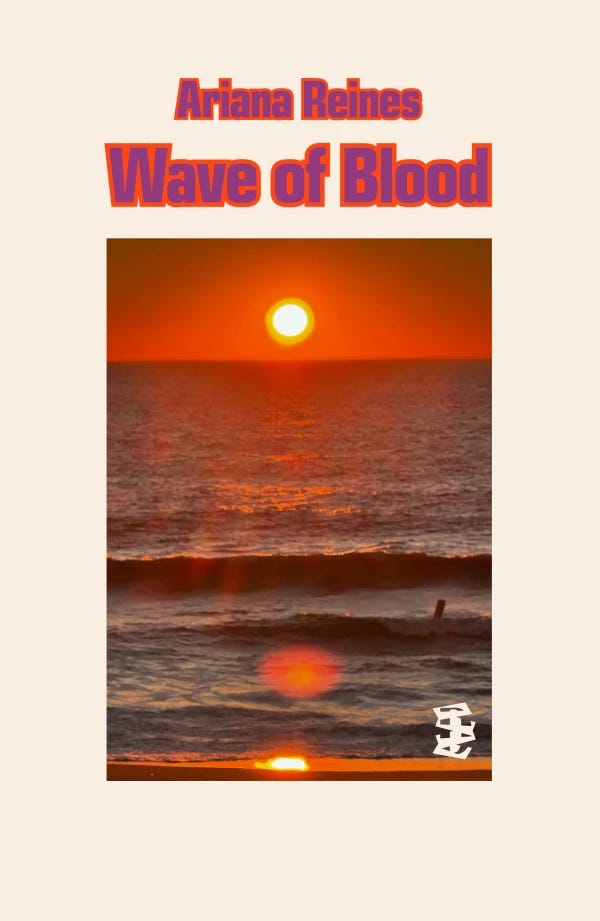
REVIEW: Wave of Blood by Ariana Reines
On the pain and poetry of living in wartime.
Despite many pages of notes and quotations, these sentences do not come easy. Each feels lugged up from some deep quarry. Writing this review is like thumbing a bruise. Why? I suspect it's because I am like other sensible animals, meaning I hurt when others hurt. Reading Wave of Blood by Ariana Reines is to stand firmly on a foundation of agony. This book is deeply honest about the pain of living today. Such honesty is hard to sort; truth resists schema. This book is not only a book of poetry—it is a protest, a vivisection. Reines wastes no time in presenting the problem: "It is like performing field surgery on yourself. Suppose no physician were available or qualified to operate on a case like yours? Suppose no physician existed with such qualifications?"1 We are blessed and cursed with uniqueness: what is now will never be again. Thus the task of self-understanding is ultimately our own. Reines cuts into her self to show us a poet applying her mind to the problem of living. But the process isn't all gore: Wave of Blood is also a direct appeal to sanity and empathy in a time of fascism and war. Regardless, the urgency of this text makes it hot to the touch; it seems immune to the neutrality required of a responsible critic. I say this because this book is not just a book: it is a scream you feel coming out of your mouth.
Let me temper myself. I will outline the book's structure: Wave of Blood is a document of the poet, performer, and teacher Ariana Reines's attempt to survive, write, and heal after the death of her mother and during the Israeli government's genocide of Palestinians. The text begins with a simple reminder: "A tortured soul can have social value." In other words, art and its dark ground—suffering, aberrance, risk, exile—are still important. This marks the book as oblique to the beliefs of those in power: that the weak and poor are grist for capital's grifts. Reines elaborates the purpose of the book: "I wrote this book to purge myself of suffering and to document a period of time." In it, we will "see and hear a woman wrestling with the mind of war." These are the book's preliminary facts.
But the truth of suffering cannot be conveyed with facts alone. Pain has a way of breaking the fences within which meaning is typically corralled. Agony explodes definition. Thus the challenge of poetry as protest, and vice versa: for others to see what you see, you mustn't be vague; for others to feel what you feel, you mustn't betray the fullness of your experience. To write poetry that combats polemic, you must be both lucid and expansive. Wave of Blood is a masterful demonstration of a writer rising to this challenge.
The book oscillates between poetry in the style of Reines's prior work—lean lines both excoriating and intimate, wired and ancient, mournful and full of life—and transcripts of talks given in public. This rhythm is a product of an artist trying hard to stay alert and sensitive to the pains of her day: you go out as long as you can bear it, you come in as long as you need. An artist's sole defeat is to withdraw completely from the duty of expression (“I have not gone numb / This is victory”), and we see and feel Reines flicker in and out and around this responsibility, guttering in the winds of atrocity. Given the chaotic structure of the present moment, the precision Reines achieves is staggering. She understands the "use value of horror," just as the poets did who sang the melodic slaughter of the Iliad, a text whose brutality illumines the faces of force and fate and rage and death. She portrays a conscious mind surviving the "computerization of the planet" as "complicity gnaws / At the root of wisdom" for all people in whose names each day "yet another atrocity is being committed." We are the subject and object of empire—and Wave of Blood displays the contortion of living both sides of such predication. Reines gets so much shit right.
But as a document of pain, Wave of Blood is animated by questions more so than answers. Some include: Who are you without your pain? Is violence, even if only self-directed, necessary? Can we stop war? Is healing possible—and if so, by which means and measures? How does one metabolize the mystical? How to be a woman now? How to be Jewish now? How does one decline to "run away from oneself"? When language has been corrupted by power, what can be said? What can be felt? And what may poetry do? Yet Wave of Blood does not wallow in unknowing; Reines makes serious claims about reality, and this book has a coherent ethical sense. She says at one point that "It isn't easy to seek a good life amidst so much moral decay"—and god damn is that correct. Reines then confidently charts some of our biggest obstacles. Even though most are yoked to their phones, the "dilated compound eye of the witness of humanity", the internet rarely compels one to leave it and do good work; causes solicit many remarks but few warriors ("You aren't standing at all. You are typing on your phone."). This machine we carry expels us into the cool realm of judgment, feeling "protected by holding the right opinion." And we who are lucky enough to not be shot, starved, poisoned, or exploded have the privilege of paying for that violence. Reines says it plain in an epochal way: "I feel like something so horrible has been happening for such a long time and it has seldom been accurately spoken of." She is talking about evil, about cruelty. And about one of its antidotes: clear and beautifying speech. Any ethics worth our future must be poetic.
Before concluding, I want to say something about mothers. Return to the book's first declaration, its steady heart now quoted in full: "A tortured soul can have social value—within certain structures and limits." Artists make their sorrow and grief into public rituals whereby others expiate their own. Yet some torture is limitless. Reines writes about caring for her schizophrenic mother—mind and body lost in the familial trauma of genocide—for decades. In one light, her mother was a soul whose boundless and inarticulable pain forbade her from helping others. In another light, her mother showed the real material consequence of all the bullshit so commonly deemed History. War, our most profane act, maims and destroys women, elders, and children—"total people," all—but these realities are rarely acknowledged by the men who would rather dub their violence good and legitimate. The hurt mother is a measure of our lack of progress. We cannot call ourselves a good society until and unless we stop making hurt mothers. I am grateful to Reines for bringing her mother to the page, and I am grateful to her mother for bringing Ariana to the world.
When writing of pain, one is tempted to exclude hope. Its tenor can feel saccharine, false, a lost dream of naivety. Yet Reines ends Wave of Blood by noting that "the way the future has always come is people start building it before the bad stuff is over." The book associates a future of our making with today's malleability of values. But aspiration cannot heal wounds that precede it—it can only prevent new ones. Ultimately, Wave of Blood documents the hurt incurred by the conscious person: by one for whom the pain of others is real and telling. It is sad to note that the world is still not run by conscious people; it is sad to say that we are still engulfed in cruelty. But I lived by an ocean for a decade and swam in it often, so I know something about staying afloat. While swimming in what can destroy you, between its slapping waves, you can come up for air, gasping at sky and glittering in light, and in those moments, you are enraptured totally in a universal desire to live. If you keep doing that—if you keep breathing and moving; if you do not go under—you will make it to shore.
All quotations from Wave of Blood by Ariana Reines (Divided, 2024).


This is exquisite: "While swimming in what can destroy you, between its slapping waves, you can come up for air, gasping at sky and glittering in light, and in those moments, you are enraptured totally in a universal desire to live. If you keep doing that—if you keep breathing and moving; if you do not go under—you will make it to shore." Thank you for your writing, whose power and beauty mean more than you know.