

ESSAY: This Green World: The Madness of the Poets
Well now here is something, I thought. Something spectacularly crashing and dangerous.


I had been working on a cracked-up story, “The Messiah Detective Agency,” when I came across Dana Levin’s book of poems In the Surgical Theatre. This was sometime in the summer of 2012. The summer of cicadas, or what we called locusts when I was growing up. There was no talk of the New Romanticism in 2012; we were still cycling through whatever it was that preceded AI. The gunk had begun clogging up the gears, but still they turned. Even so, there were those of us who passed between us, like some samizdat fragment, snippets from Wordsworth’s sonnet “The World is Too Much With Us”:
The World is too much with us; late and soon,
Getting and spending, we lay waste our powers; —
I was on my way to meet a friend who was riding his bike across the country (so he claimed) making his way from Salida, Colorado, and I stopped at Dawn Treader Book Shop, in Ann Arbor, Michigan, to find a used book—any book—to talk about with my friend because I was afraid that, despite the closeness of our childhood years, we’d have little to say to each other now, thirty-years later.

An object like a book, I figured, was something I could slide across the bar during an awkward silence and say something like, “Have you read this?” I suppose I chose In the Surgical Theatre because of the title and the cover image, “The Infant and Womb” by Leonardo da Vinci.
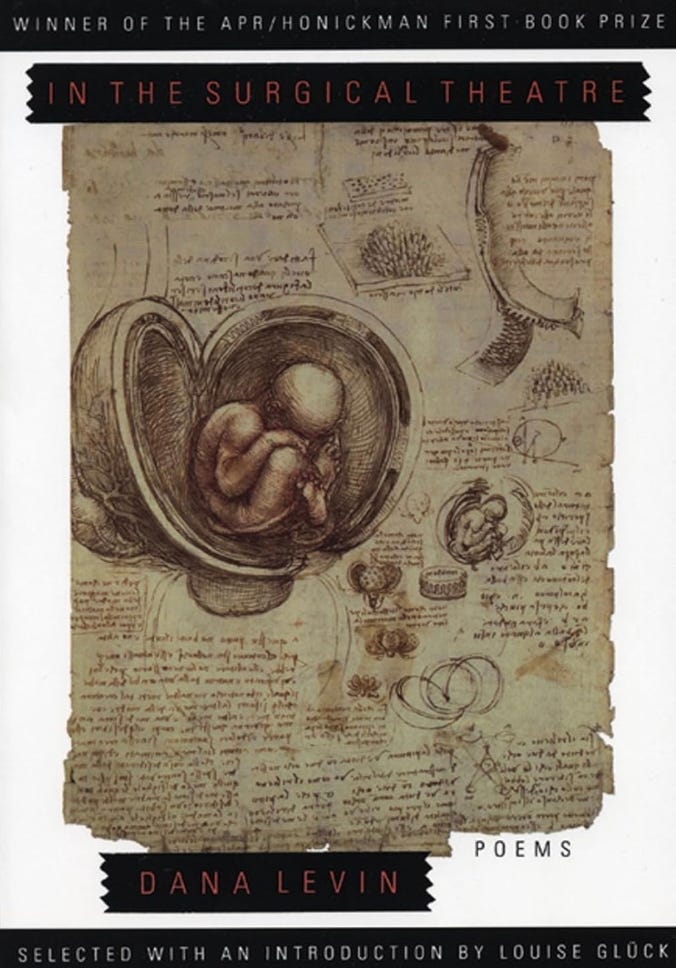
As I recall it was perched atop a stack of books (there were scores of these stacks and half-fallen stacks around the store) on the floor because there was no room to put them in the stuffed shelves. I opened it to these lines:
make us, make us be
be—
something else for a while.
Or nothing else for a while, a series of stunning self-
destructions: point A
where we slit our throats, point B where the paper shredder
churns us up, and
C the slash, the cuffs, the gun, all evil bloodied
and done—
Well now here is something, I thought. Something spectacularly crashing and dangerous (“point A / where we slit our throats”) (how had Levin pulled off that “gun,” “blood [ied],” “done” slant rhyme?) and as I held the book open to those lines I felt the eyes of someone watching me, but of course I was alone except for the young woman at the front, behind the old cash register, reading a tattered book of her own, her black hair pinned back above her ear with a pink barrette and a tattoo on her forearm that was also pink, in the shape of a smiling skull. There were no eyes watching me, at leas not that I could see.
So I bought the book and made my way to the bar to meet my friend. The poem’s line “a series of stunning self-destructions” rattled around in my head as I made my way in the sun past the old theater with its grand, faded yellow marquee and then cut through the cobblestoned back alley that led from the commercial to the grubbier college district. I thought of the character, Chiyuma, in that story I was working on and how he himself—in an effort to solve a murder—had been drawn into a dark world he wanted to be “something else for a while.” At the bar, which one entered at the bottom of a long, dark set of worn wooden stairs though a nondescript alley door marked simply, in white chalk, with the letters AXX°NN, I found my way to a booth at the far corner, beneath a small window that let in a shaft of sunlight, and learned more about this Dana Levin. In her brief introduction, Louise Glück wrote that In the Surgical Theatre was “a book of terrors and marvels” and mentioned the “tidal power” of the poems. At the back of the book I looked for a photo of Dana Levin, but there was none. I learned from the bio that she grew up in Lancaster, California in the Mojave Desert and I immediately had an image of her, as a girl, separated from her family, suffering just at the point of exhaustion and dehydration. I imagined her coming across a sheer white skull of some small animal and, lifting it out of the hot sand, deciding that she needed to invent a new order of words to capture this moment.
I ordered a beer and set it just within the golden triangle of sunlight on the table’s surface. In the book, on page 31, a poem entitled “Field” opens with these two stanzas:
The antelope white against the charred hills
eaten by fire,
the golden trees, the upstairs window,
something
is running across the field,
can you see it coming
through the yellow grass, can you see it coming
from the windowpane,
are you closing the shutters, do you think it is rain?
There is something topsy-turvy about those opening lines, the way they take you from the wild to the everyday and familiar: a window. The window is imbued with a certain terror, but how? The stanza ends with the cryptic “something” with no punctuation to help navigate us in or out of meaning. We are stranded, in the most pleasurable and terrifying way possible. And then: “can you see it coming.” The fact that it’s coming—the antelope or the rain or, more likely, the evil—is inevitable: there is nothing to be done about it, no way to stop it. I think of this evil as green; green because it is alive and growing, the way you know a bush or a tree is alive by snapping a twig to reveal its cool, soft, green interior.
I’d heard of Louise Glück, whose introduction to Levin’s book hadn’t quite prepared me for the potency of the poems. I had not read Glück’s own work, but I’d heard that it was arid. Years later, I was at a reading where a poet, in warning the audience about the rawness and triggery-ness of her own poems, made a snarky comment about Glück, something to the effect of “be prepared, my poems aren’t nice and nature-y like Louise Glück’s,” which of course made me immediately side with Glück, whose poems I’d not even read. To see for myself just how nice Glück’s work was I bought a copy of Meadowlands right in the middle of that other poet’s reading.
Meadowlands, reader, broke my heart:
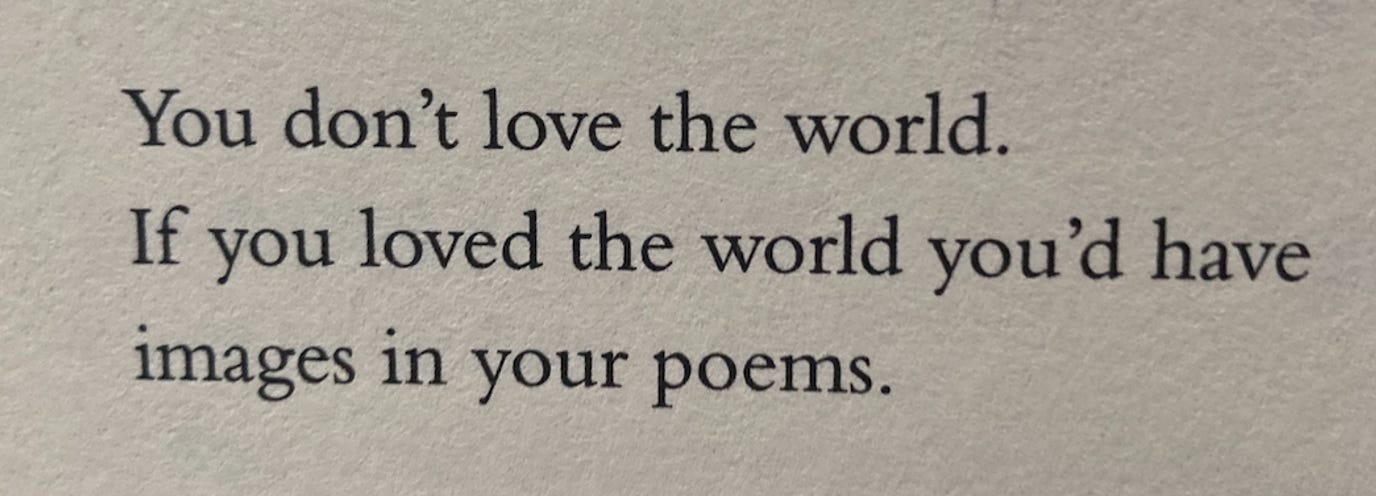
You don’t love the world.
If you loved the world you’d have
images in your poems.
That’s how “Rainy Morning” begins, a title so innocuous and boring that you are floored by those opening lines. Was this Glück condemning herself, in her seventh book of poetry in 1996, to the charge that others had laid at her feet? I understood pretty early into Meadowlands that what I’d heard about Glück didn’t square with what I was reading, poems that didn’t even sound like poems to me, but more like little manifestos against the self. Darts of pain. And oh how I was familiar with abusive self-critique, my mind racing to dump shit on my work before anyone else could.
Pile up enough little manifestos against the self and you end up with one big collage of self-loathing that, in my case at least, you could only attack through writing. Put your pain into your writing—like I had to because where else could it go?—and you’ve got at least some sort of answer to the self-hate. You’ve made something at least, fragile monuments, something to share with the world, something that someone, somewhere might find makes them a little happier, and in their happiness you find your happiness. There it is: your happiness is bound up with the happiness of others.
“You don’t love the world.” What an accusation, something that hurts even more as the very first line of a poem, because if you don’t love the world, at least a tiny little bit, how can you write poetry? But like I said, that was all in the future, Glück waiting there on the horizon for me. Right now I was in that little bar waiting for my friend. The sunlight had moved across the table. A woman at the bar was smoking—actually smoking! No one stopped her. No one asked her to step outside. This was a good sign, I thought. There was, above the bar, a photo of Osama Bin Laden with a black X Sharpied across his face. There was a large jar of pickles, pickles suspended in liquid, and some of them were pink and some of them were yellow.
I opened up Levin’s book. “Movie” is a poem about just that, and in the fourth stanza the speaker observes the crowd in the theater:
And the two kids: what did they want?
A little chaos, a little blood
to make their day, their unpredictable fragmented day-
And the man,
what did he want?
O long tunnel out of despair, distraction of someone else’s
story—
There in that bar, not too far from anyplace and not too close either, the words of Dana Levin—a person I had never met but felt as if I had known for as long as I remember knowing people—moved around on the page and rearranged themselves in black and white, and, oddly, green. “Long tunnel out of despair”—why was that line in a poem and not the Bible? During those years I carried with me photocopied pages of some of Keats’s letters. It was a sort of tic, a good luck omen I thought. These pages I unfolded quietly in my lap, turning my attention to this, from a letter Keats wrote to John Taylor in 1818, describing the goal of poetry:
Its touches of Beauty should never be half way thereby making the reader breathless instead of content.
That’s how I felt reading Dana Levin: breathless. The longer I waited, the longer I was certain that my friend would not show up. The tone of the bar turned devious. The smoking woman had put out more than just her cigarette. Her eyes had been put out, too, it seemed, as she stared at me not with eyes with two black, soft, watery holes. Another woman with shocking pink hair spoke quietly but with vicious intent into her cell phone, and somehow I knew that there was no one listening to her, and that her phone wasn’t even on. Why was she pretending to speak on her phone like this? Who was this act for? Me? And if so, why? “The problem of light. / The problem of it, / flaming down / against the punched out panes of the abandoned mill,” go the lines in Levin’s “The Problem of Light,” and all I could feel was the bar tilting like the inside of a wooden ship in a bad sea adventure movie like the ones I watched as a kid. Everything shifts into the present tense for a few moments.
My drink practically slides off the table.
The bartender fades in and out like a picture on an old TV set.
The woman with pink hair buries her face in her hands and seems to weep. Then I see, between her fingers, that she is secretly laughing. The laughter of absurdity, as if an idea had just occurred to her that would change her life forever.
I began to wonder about my friend, and why he had left me stranded here, and months later, when I discover that it was tragedy that had prevented him from meeting me, I will think back to the Dana Levin book and the afternoon which seemed to stretch beyond reason from one era into another. By the time I left the bar it was already dark (I could hear the tiny, pinprick hearted crickets in a field across the way) and from beyond the shadows in the alley cast by the moon came dry voices that quieted as I approached, as if some terrible secret (the fate of the world?) was being decided right then.
A month later I did finally meet my friend at that bar. He was a broken man, I don’t know how else to put it.
Disheveled and unshaven, his black hair long and greasy and almost curling, his eyes hollow and out-of-the past, like one of those haunting Civil War photos of men in their tents between battles, hungry-looking, wane, lean, close to death and some of them grinning at this closeness to death.
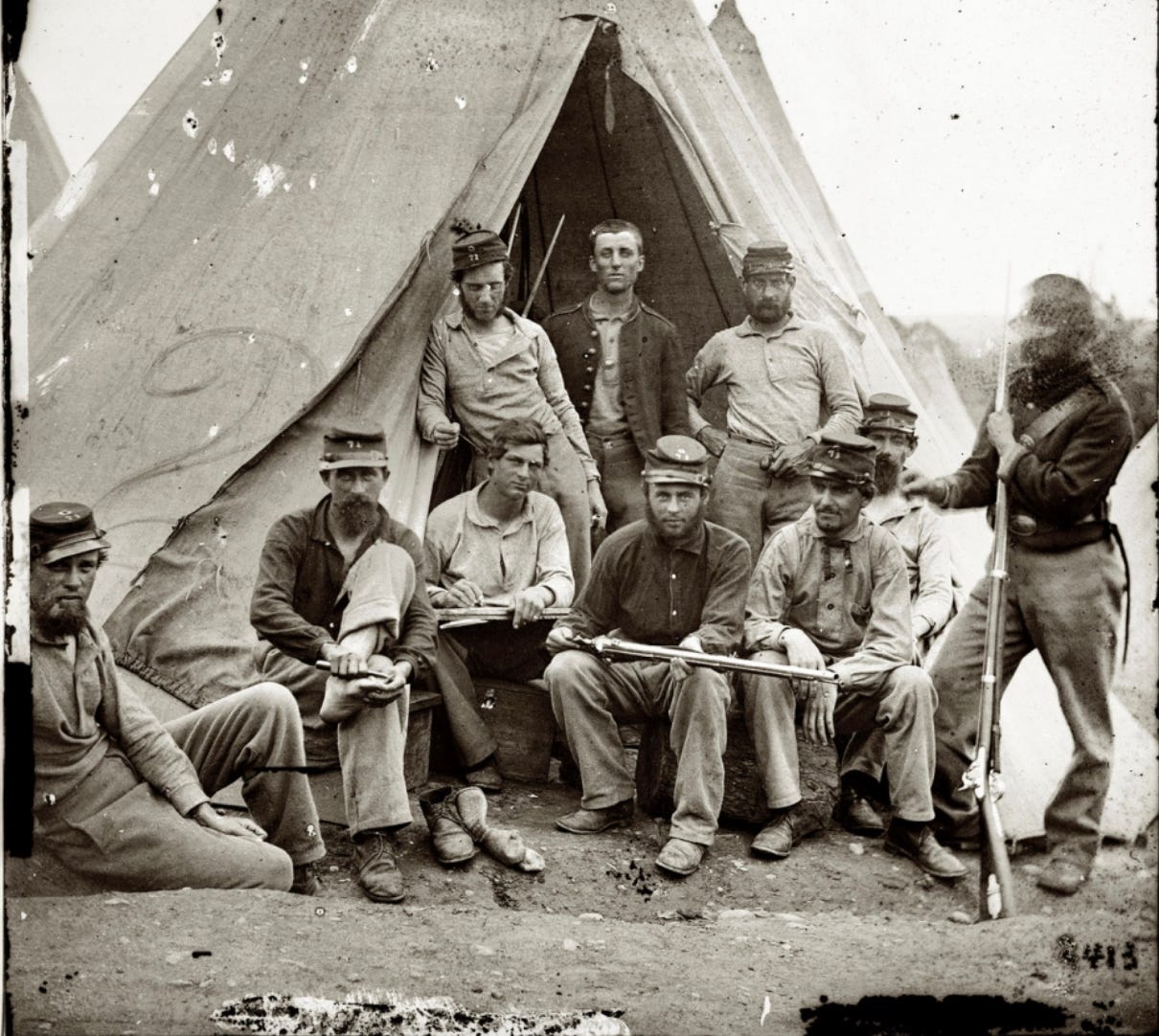
He looked devastated, what can I say? I spotted him from across the room and waved him over. There were more people now, and even he—in this locus of misfits—seemed out of place. He limped over and sat down across from me and placed his wind-burned hands face down on the table, as if trying to hold down some terrible fact. We ordered drinks, and talked, and ordered more drinks. He spoke in blunt, fragmented sentences, like from the old days, when we spent so much time together in nature that we practically forgot how to talk.
He had indeed been riding his bike across the country and that’s when the assault had happened, he told me, his vacant eyes staring at the EXIT sign.
“What they did to me, what they did to me was inhuman,” he said of the gang of men and boys who took him down on a country road not far from Jackson, Michigan. I knew Jackson, Michigan enough to know to avoid it.
“What the hell were you doing in Jackson?” I asked.
“It’s where the bike path goes through,” he said. Then, referring to his attackers, I think: “They looked like woodsmen.”
“That can’t be right,” I said. “It doesn’t make sense.”
At some point he said, of the Dana Levin book that I had brought with me again and that had been lying there between us, “I can match that.”
From his mangled backpack, he pulled out a small package wrapped in brown paper. The wrapping was covered in smeared black X’s, like something you would see, I imagined, on the inside wall of a prison cell. He set it on the table, and gently pushed it across the surface to me, between the beers. I knew immediately that it was a book, and I took the wrapper off carefully. A book of poems by Olena Kalytiak Davis, shattered sonnets love cards and other off and back handed importunities.
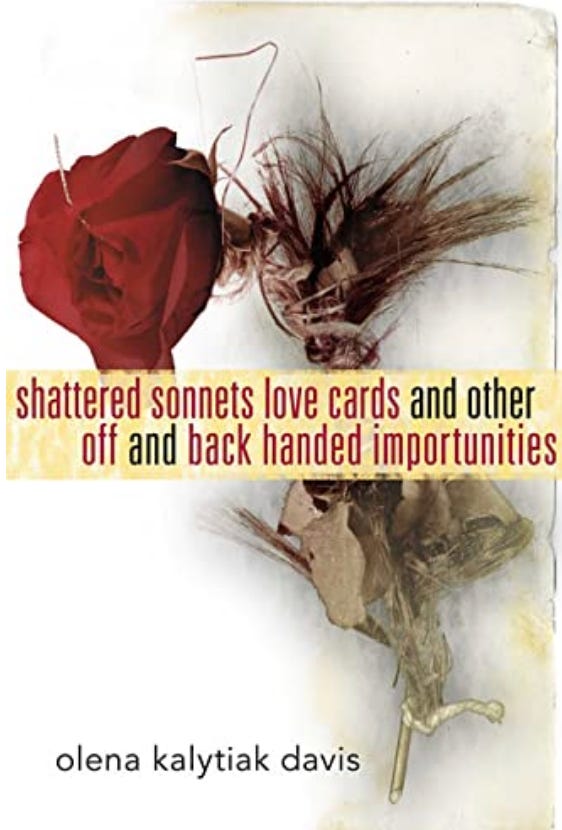
This was a book that I had once owned, and then lent to someone who moved away, taking the book with her. I remembered it in fragments, and opening now to the first poem, “dear reader, flannelled and tulled,” I suddenly remembered why I had fallen under her spell:
Reader unmov’d and Reader unshaken, Reader unseduc’d
and unterrified, through the long-loud and the sweet-still
I creep toward you. Toward you, I thistle and I climb.
That repetition, in the middle of the line—toward you. Toward you—and the secret recognition that something is coming (“Something is running across the field”) is enough to knock your world off its axis. Things spin differently in the spaces of Levin and Davis, and I could see that my friend had become illuminated by the light of Davis’s words, just as I had, and that they’d gotten the better of him.
“Here,” he said, taking the book and leafing through its pages, “look at this.” He handed it back, pointing to these lines with a crooked finger that clearly hadn’t healed right after being broken:
Hence sordid bullshit, leave me the fuck alone,
with my milton and my dickinson
with my browning and my keats
with my quillless pen and my yeats—nothing
rhymes anymore, yet it is possible to master
to make it neat, when allaroundyou is the disaster
of soul on soul gone bad, rotten or rotting
from the edges on in.
I wondered what my friend intended; why these lines? The near-rhyme of Keats and Yeats (“nothing rhymes anymore”). Somehow I feel that’s it’s important to say right here and now that, at some point during the evening, as we passed the book back and forth, a slip of paper fell out and onto the table. Affixed to the reverse of this piece of paper was another piece of paper with two black X’s crayoned on. Then my friend began speaking quietly, leaning forward.
“I can only say this once; they are listening probably already. Don’t worry. It’s not that sinister or dangerous, at least not yet. To look at me you’d think, what a mess; what’s happened to him, my old friend? But deep inside, Nick, I’m the same person you’ve known from way back. This poet—this person—named Olena Kalytiak Davis, her words have restored me inside, so don’t be fooled by my appearance. I don’t even read poetry; you know that, right? We struggled together in that class in college. Do you remember? On the metaphysical poets?”
“Of course I remember,” I said. “The class was a trap. None of us wanted to admit how shocked we were by the poems. We pretended not to care because caring seemed passé.”
“Except for one poet,” my friend said. “We were proud to quote him around the campus. It separated us from the others, somehow. Do you remember his name?”
“Andrew Marvell. How could I forget? The one with curls.”
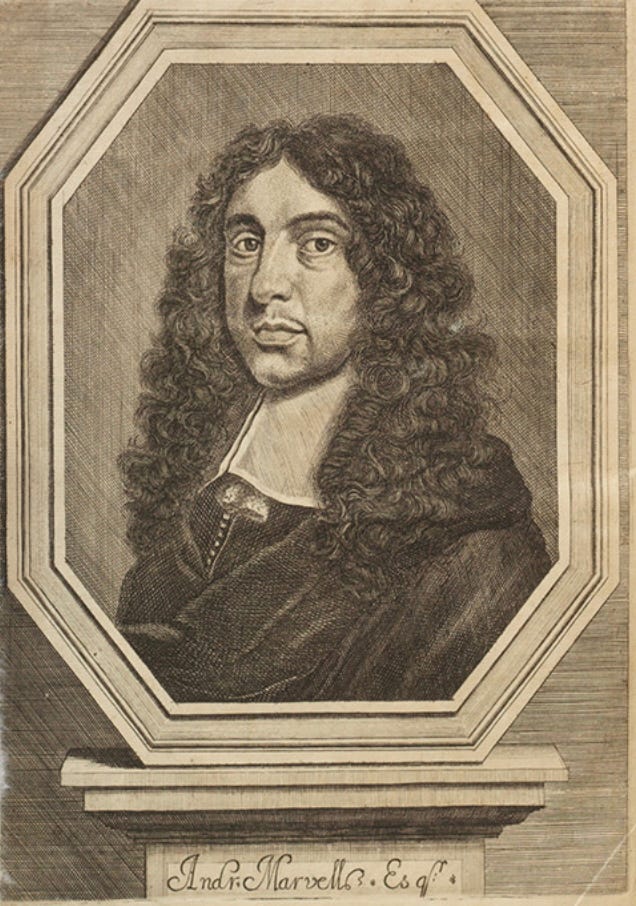
“They all had curls, don’t kid yourself. And nice lips, apparently. Do you remember the poem we quoted from all the time, ‘The Garden’?”
“Parts of it,” I said. “Not really.”
A gust of wind blew the back door of the bar open, and a hurry of dry leaves swirled in. Drunk people batted them away and fake-screamed like they were in a horror film. I loved this life I was in. I loved this moment. My friend opened shattered sonnets to another page where, in the margins, he had hand-written, in careful black-blue ink the color of a horsefly, the following stanza from Marvel’s “The Garden”:
Meanwhile the mind, from pleasure less,
Withdraws into its happiness:
The mind, that ocean where each kind
Does straight its own resemblance find;
Yet it creates, transcending these,
Far other worlds, and other seas;
Annihilating all that’s made
To a green thought in a green shade.
Annihilating all that’s made / to a green thought in a green shade.
It seemed remarkable and terrifying that these lines could have been composed in the seventeenth century, as if the twentieth century had some sort of magnetic pull on Marvell, coaxing composted words out of him that more aptly described our mid-twentieth-century total war horrors. I could see now why my friend had fallen into the language of Olena Kalytiak Davis, and why he considered her a metaphysical poet:
The soul that selves. The starfish.
The soul that faiths. Yet remains
Faithless. The soul that prefers
to decline. Dirndled and kirtled, the queen’s
soul: the longspun, the finespun,
the dizzy soul, spun
finer and finer still. The still-
born soul
It’s there, some form of dark magic, in the near repetition of words: “finespun / spun finer” and “finer still / still-born.” As if language is an infection that cannot be killed by securing individual words to lines and patterns and nailing them to meter, where they will only dislodge themselves. Dirndl and kirtle are both words referring to dresses and in Davis’s poem they seem to be in orbit around each other. I realized now that that’s where my friend was stuck—somewhere in between Davis’s orbiting words. (Davis has said, in an interview, that “I can easily live without poetry, but I absolutely cannot [cannot!] live without fiction,” which I think is key to reading her more confessional poems.)
My friend began to tell me what had happened to him. The gruesome details of the hours-long assault that occurred on that dark, forsaken country road in Jackson. The light inside the bar had taken on some forbidding sepia, the colors washed-out in a grayness that reminded me, again, of Civil War photos, the blank, open skies above the bodies. I could tell that my friend’s mind had become snagged on something many years ago, and that he was still trying to unhook it. Perhaps he thought that by telling me his story—fragmented as it was—he could somehow work his mind free from whatever had caught it. On the other side of the room, a fight broke out, and a young man who looked like he was majoring in economics took a terrible hit to the face and even from our distance we could see the blood.
By this time things in the bar had gotten out of hand. Clearly the place was openly courting some cosmic disaster. It seemed as if a switch had been thrown somewhere, and everything became charged with danger. In fact, this could have been the closed set of a horror film where—inexplicably—all the actors have suddenly been exchanged for real psychopaths. My friend seemed to sense this too, and he slid the Olena Kalytiak Davis book across the table to me, opened to page 25. Did I even need to read the opening stanza from the poem “in one of my lives–” to know that the word green (“a green thought in a green shade”) would appear there, as some alarm, some last-ditch signal to warn me that what I felt in the bar that night was just the very edge of an evil whose scope was far greater than I could possibly imagine?
This one—If I must Be—
Exact, all others hid their edges. A Tide
Passed over the long black grass, the sky Grew
Green and bigger, I drank red potions in Satiating
Portions. But—having Nothing—
To compare it to—I Saw
Felt, tasted Nothing.
I understand, dear reader, that we live in an age when the concept of evil has been blighted by the Enlightenment, and I am, in many ways, thankful for this. And yet, as Max Horkheimer and Theodor Adorno remind us in The Dialectic of the Enlightenment, “the fully enlightened world radiates disaster triumphant.” I am also thankful that, with the help of my tragic friend, I discovered a very narrow path through the words of the mad poets into the infernal corners of this green world.
And as for that friend, he disappeared from my life soon after. The last I heard from him was a worn black postcard that stained my fingers, its postage stamp’s denomination an undecipherable number, its landscape one that existed beyond all recognition.
This is one hell of a good read.
I love to read about the experience of reading. It's so bodily, and in the machine age, bodies are our big advantage (maybe liability).