

COLUMN: Big Emotions #7
The quality is ashes to ashes, dust to dust, energy to energy.


I’ve been avoiding writing this column. Maybe because it’s the last one. Really it’s because I don’t think God is real. I grew up in the Bible Belt; I went to church on Sundays and sometimes on Wednesdays, too; I have vague memories of Vacation Bible School; at football games on Friday nights I bowed my beribboned head with the other cheerleaders as the Lord’s Prayer (the Protestant version) was illegally blasted over public school loudspeakers; but never once, not when I was five, not when I was seventeen, did I believe. This was due in large part to the fact that my parents also did not believe. Going to church in the small-town South was the smart social thing to do. And also because our denomination, Presbyterian, a.k.a. “the Frozen Chosen,” was boring. There was no incense or sexy Jesuses or blood wine.
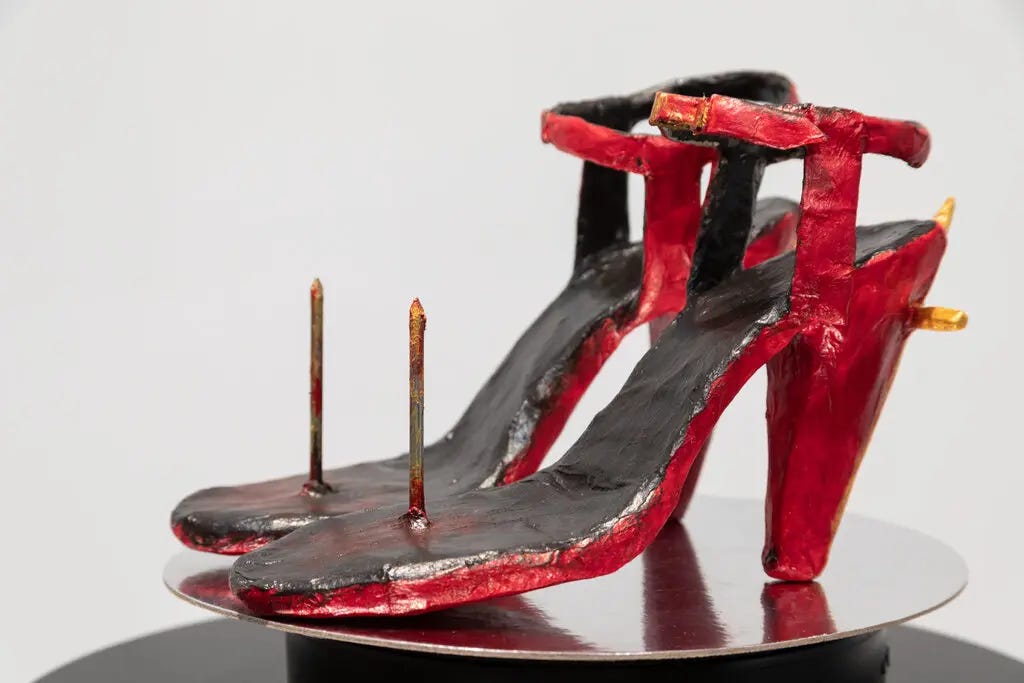
After I left home my mother started to transform into someone else. She did this via religion. First she started going to the fun churches with the amplified guitars, then she started going to the wild churches with the speaking-in-tongues and the snakes, then she started going to the crazy churches that don’t believe in medicine. One of these Pentecostal preachers came to her funeral. He was a very nice man with a beautiful singing voice at the height of COVID and I wanted to spit in his face. But it wasn’t his fault she got sick. What I found in the journals stashed under her bed was that she wasn’t happy with his church, or any church she’d found. She wanted to start her own church and in this place, my mama’s church, what would happen is true ecstatic transcendence.
In my life I have experienced truth, I have experienced ecstasy, but I have never had a transcendent experience. I have been in the presence of someone who has and this person was not well mentally and during his transcendence what he did to himself was horrifying. But me, even on healthy doses of my least favorite type of drug, psychedelics, I’ve always been aware that it’s my brain, and not the universe, that’s talking to me. I say this to say that I am an imperfect vessel for this final quality that it might behoove the fiction of today to explore. But I can’t help it; it’s only logical. For what comes after energy, mystery, seduction, architecture, palimpsest, and entertainment, but transcendence?
Now that I’m at the end, I want to consider the beginning. In that first column, on energy, I mentioned an energetic sentence of an energetic writer, Denis Johnson. But really I had a different line in mind. In my mind the ending of a certain story in Jesus’ Son, of two drunk drunks, male and female, dancing in a bar was transcendent. But I hadn’t read this certain story in over twenty years and when I revisited it, again, I couldn’t help it: it felt sentimental. Here it is, after the male drunk kisses the female drunk, at the end of “The Other Man,” he thinks:
It was there. It was. The long walk down the hall. The door opening. The beautiful stranger. The torn moon mended. Our fingers touching away the tears. It was there.
The moon and the tears are too much for me, but as I accumulate days and days I understand more and more the impulse to reach—outside of oneself.
Weirdly, a transcendence I can get down with without reservation is predetermination. What’s weird is that this was the doctrine wafting through the Calvinist air on the Sunday mornings and sometimes Wednesday nights, too, of my childhood. The Presbyterians are called the “Frozen Chosen” not only because they are a reserved Scotch-Irish crew but also because they believe that God has chosen if you get salvation or not before you are even born, and there’s nothing, nothing in life you can do about it. As an adult this is an unboring idea to me, not the God part but the predestination. What I do believe in is that free will is an illusion. Because there’s a gap between action in the brain and the brain’s awareness of it in a causal chain back to the Big Bang and forward to the end of everything. Anything that we do, from murdering someone or not murdering them, to choosing a banana over an apple for breakfast, has already been determined before we are even aware that we are “deciding.” And as it’s impossible to go back in time and make a different decision there is, therefore, no such thing as free will. We are never truly in the present either, not even visually, as there is also a gap of time before the light being emitted by your screen right now, for example, meets your reading eyes.
Of course, this is almost impossible to take seriously because every thought in our brains is telling us that we can choose, and that our choices have consequences regarding what happens next to us, as if we’re in control. This is our physical experience, just like our physical experience is that our planet is flat. But if I could somehow reach so far outside of myself as to appreciate fully the implications of a determined universe, that’s where my transcendence would lie. Maybe it would be ecstatic and true, too, like:
Like you I was created at the Big Bang, with all the other energy. One day the sun burns out. With the rest of Earth’s energy I flee its collapsed atmosphere. I wander space with everything else that ever was or ever will be, like my mother and all mothers, like my novels and all novels. We are not wandering randomly. We are stretching and stretching, wanting and wanting, like we always have. At the very edge of this stretch, at the point of all tension, the universe begins to pixelate. The energy that was once—for an infinitesimal time—me fragments and so does the energy that was once—for an infinitesimal time—you. On the other side of the end there will not be nothing. Because there will not be. For a moment, however, we are still everything. Before the sound of all sound swells, before the light of all light blinds, before the big, primal snap.
From the beginning of my consciousness, my sense of self has been consistent. Maybe this is not a fashionable thing to say: but I have always been the same person. I have never transformed into someone else. I have an assessment of myself, age five, typed on a typewriter by my kindergarten teacher when the Berlin Wall was still standing, and nothing has changed. “Katherine is fascinated by maps.” “Katherine chooses her activities independently and completes them.” “Katherine seems shy at first.” “Katherine enjoys reading very much. She composes original stories and writes them down.” Or you can see for yourself, if you so choose, by reading the first essay I was ever commissioned to write, for The Paris Review when Obama was still president, six months before my first book was published. I was snarkier back then, because I was younger and life hadn’t yet done to me all that it was about to, but nothing has changed. It’s called “I Would Like to Write a Beautiful Prayer.” It’s about being a writer who grew up in the South but never took religion seriously. It ends with a vision of the end of the universe.
I remember thinking it was too short, that I couldn’t think of anything else to say without repeating myself, and that therefore there must be something wrong with me. I have thought this at the end of everything I have ever written. I’m thinking it right now in this present moment that is already past. I’m thinking that I’m pretty sure I’ve written that previous sentence in some other essay in some other place in some other time. So here is where I leave you.
I hope the emotions have been big. I hope you’re as wasted as me. I hope the pizza was spicy and the cigarettes were minty. I hope we’ve danced together. I hope we’re both slightly embarrassed about all that we’ve said. I hope one thing we’ve talked about is what’s so great about the novel is that it can be anything it wants to be. I hope we’ve glimpsed it at least, whatever we were looking for, and thought, It was there.
There is no next month but there is not nothing. There is no need to go home but we can’t stay here.
Excellent, thank you
I'm sad this series is ending. Thank you, Katherine!