

CONVERSATION: Daniel Pope on Crows, Moms, and Helping Yourself
"Should I be like, Hey mom, just so you know, this book is not about you."


I met Daniel at the Kenyon Review Writers Workshop in 2022; he was late to our first dinner as a workshop group, because he’d accidentally eaten with the high school lacrosse boys upstairs. Since then, he’s been much less embarrassing, and has in fact written a really good debut novel.
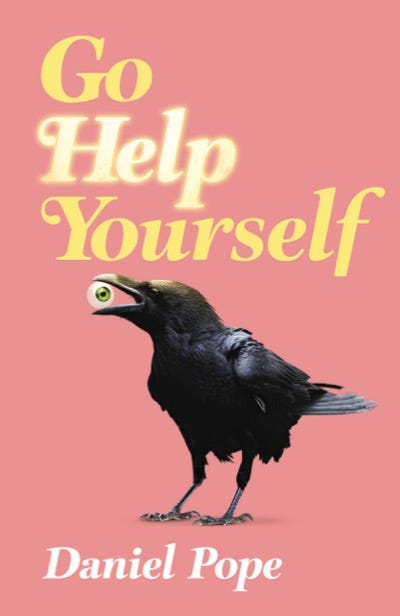
Go Help Yourself catches Corbin Moore at a crossroads. He’s been dumped, the bookstore where he works is running out of money, and he spends his time bingeing food and weed and the news. His mother, a famous self-help guru, enlists herself to get him back on his feet, setting off a series of messy events and a spiral of realizations about what’s important, what’s bullshit, and what’s the deal with crows. The novel won the University of New Orleans Press Publishing Laboratory Prize and was published in May 2026.
In July, Daniel and I navigated time zones to chat over Zoom.
Chloe Alberta: Can you remember the first line of your book off the top of your head?
Daniel Pope: I can. Midway through my life’s journey I found myself at the marijuana dispensary.
CA: Good, you passed.
DP: Oh, this is a quiz. Okay, cool.
CA: This is your first published book. Yay! How long did it take you – I’m smiling. This is weird to do with your friends.
DP: Well, it’s weird because I feel like I’m stepping into this symbolic role of the author, but I’m just talking to Chloe. Also, I’m just like, how are you not vomiting in your mouth when you’re asking me questions about this? I feel really cheesy.
CA: No, this is good. It’s good banter. Alexandra Kleeman told me something at the Kenyon Review Workshop, and I’m paraphrasing, but she said your first book should be like you ripped out your heart and put it on the page. Do you think that’s true?
DP: Gosh. ‘Cause you know, this is just the first one that’s gotten published. I’ve started all these other ones. But I think this one did get published because it was cutting closest to the bone for me. So I do think you have to tap into that, if you haven’t really written a lot of novels, and you haven’t found your process. Every novel is like a different clock you’re entering into and trying to figure out how to build it from nothing. It has different rules. So maybe as you’re trying to learn your rules and your process, it’s best to do something that feels vital and important to you, life or death, almost. You have to find that beating heart and follow it. And that’s what pulls you through all the bullshit, all the uncertainty and the doubt and just repeatedly coming up against the limits of your own ability. But then eventually, if it’s important enough to you, you can scale that wall. I would say that that’s probably what happened in this case.
CA: Corbin is trying pretty hard to get people to dislike him. And at times it feels like you, the writer, are trying to say, “Look how shitty Corbin is. Don’t you hate him?” But even when he’s being a dick, I ultimately feel quite tender towards him. There’s an element of hope that comes from this downward spiral. Tell me about how you conceptualized Corbin, and how do you feel about him now that he’s fully written?
DP: He’s such a part of me. The bitter cynical part of me. But the thing about cynicism is that it comes from an expectation that things should be better than they are. So there’s a naivete to Corbin. It’s true that he’s often compulsively joking and trying to needle people and taking refuge in ideas about himself, and hating himself. You can hide in those things, and convince yourself that you’re protected from disappointment because you’ve already inoculated yourself to it. It’s a defensive maneuver, like, okay, you’re not going to like me anyway. I might as well just pull the trigger myself. Then you’re in control.
CA: While you were writing, were there books that you hoped it would end up like? And did those align with what it actually ended up being comparable to?
DP: I thought of Stephen Florida by Gabe Habash, which was more aspirational than anything.
CA: I definitely see that! Because Stephen Florida has a similar thing; he’s pathetic, but he’s also sympathetic. And he is hardcore about his body. Which is not that well represented in contemporary literature, I don’t think. Male body image issues, disordered eating, that kind of thing.
DP: Well, so much of it presents through the self optimization, grind set kind of shit. Which is not always visible as an eating disorder necessarily, but I think that’s what it is. People want to change their bodies so much and it pops up in different ways with different perspectives and genders. I see Corbin as an embodiment of two contradictory messages: the command to enjoy, consume, relax; or on the other side, to master yourself, be productive, control your body. These can be equally tyrannical and toxic in excess.
In men and literature more generally, I think eating disorders like this are almost not culturally legible. For some men the stakes of beauty have never been higher, because so many men see beauty as the ticket to some kind of fulfillment they think they’ve been promised. Ultimately, they’re looking for individual solutions to what is a cultural problem, which is that we live in a culture that is incredibly hostile to the human psyche, and everything seems completely fucked and beyond our control. And some people, given that situation, turn to their own bodies as the one thing they do have control over. Literature could be a good place to explore and understand these dynamics without a directly ideological or moralizing lens, which can sometimes distort the picture.
CA: For Corbin, the disordered behavior is also tied to his mom, and the way she influences him to think about his body. They’ve got such a complicated dynamic. They love each other, but treat each other really poorly at times. One of my favorite scenes is where she’s chasing him around the restaurant, trying to make him eat pudding. Has your mom read the book?
DP: Ha. Yes. Yeah.
CA: What does she think?
DP: Well, for some people, the book arrived early. So I was coming home to Seattle from Manchester, not expecting her to have already read it, wondering, should I say something ahead of time? Should I be like, Hey mom, just so you know, this book is not about you. But I was thinking, if I said that it would totally sound like I’m saying the opposite, right? So I didn’t say anything. Then I got home and she had already read it. And she liked it, but there was a bit of a tentative kind of “what’s going on with the mom” thing. But if anything, my mom might play this character momentarily as a joke. She’s a very theatrical person. She’d probably put on a fake British accent and be all pseudo elegant like, “Oh, I mustn’t.”
And then I dedicated it to her. But I was worried, are people going to read that and think, Oh my God, that’s so mean, a dedication.
CA: No, I think that’s actually so smart! I don’t think a dedication ever implies a vengeful feeling.
DP: You’re probably right. You put too much of yourself into a book to then be like, “Oh, I wrote this out of spite.”
CA: I don’t think anyone ever thinks of a dedication as revenge. Although maybe that should be a thing.
DP: I mean, I would do it. Absolutely. Next book, I’ll do that.
CA: Dedicated to Chloe Alberta.
DP: Exactly.
CA: Talk to me about birds. In Go Help Yourself, the crows are maybe out to get Corbin. They’re lurking outside his house, they’re divebombing his picnics. Overall it adds this almost surreal element to a book that’s otherwise pretty drawn from the real world. What fascinates you about crows in particular?
DP: Well, they’re omnipresent in Seattle, for one thing. And they’re like a collective character in a way. When you start noticing them, they just have so much personality, and they have so many different calls. They’re so intelligent. They hold these grudges. So a lot of the stuff that the crows do in the novel is in fact also pulled from the real world. It is an irreal element, but that’s only because reality is a story that we tell ourselves about the way the world is; it’s not actually the world. Reality is this social narrative that comprises certain laws of cause and effect. This is also what realism is, because something that’s very, very real, in fact, could look like irrealism or surrealism, because it diverges from the way that we think reality should act. I find crows fascinating, because they’re so intelligent, but it’s this weird alien intelligence, this collective intelligence. Which made me think about the ways in which stories use elements of the unconscious, I guess, if we want to get annoying and Jungian about it. A lot of it is about encountering the shadow within or whatever.
I don’t really like Jung, by the way. I want to tell the reader that I don’t really like Jung.
But I think it’s also about understanding that the crows are their own autonomous things and Corbin’s projecting onto them. But he’s projecting for a reason. What’s the saying? If you think the whole world smells like shit, then maybe you’re the asshole.
CA: Is it on purpose that the name Corbin sort of sounds like Corvid?
DP: Ha! Next question. No, but somebody did say to me, you can’t have the main character be called Corbin and then have him attacked by crows through the whole book and then never call attention to it. But I kind of liked it as an example of nominative determinism. And it seemed like a classic novelistic thing to do, to name a character after some element of the story.
CA: That’s what literature students will be writing their papers about when they read this book in 400 years.
DP: Oh, sick. Yeah. I think about this a lot, actually. Contemporary literature, when people read it in the future, they’re gonna be like, what’s Tinder?
CA: Ok rapid fire round. You have three seconds to answer.
DP: Cool, cool, cool.
CA: Would you rather be trying to finish a first draft of your first novel or have completed your first draft, but you’re sort of wet all the time?
DP: Oh, fuck. First draft. I don’t want to be wet all the time.
CA: Would you rather be a debut novelist at your very first book launch event, yay, or hanging out with Björk?
DP: Book launch, ‘cause I’m gonna make an ass of myself in front of Björk.
CA: Yeah, you would. Would you rather be a debut novelist who is looking for an agent or a squid living in the ocean?
DP: Well, I am a debut novelist looking for an agent, so I’m not enjoying that. I’ll take the squid. Squid sounds fun.
CA: Do you think your friends love you more or less after reading your book?
DP: I hope more, ‘cause maybe they know me a little better, but probably less ‘cause they know me a little bit better.
CA: Who is the greatest writer of all time?
DP: Maybe Isaac Babel or Denis Johnson?
CA: Who is the greatest interviewer of all time?
DP: Chloe Alberta.
CA: Correct. Who would you rather have dinner with, me or Denis Johnson?
CA: You’ve been thinking for a really long time.
DP: I’m sorry, I’m gonna have to choose DJ here, but I would love to have dinner with you as well.
CA: Wrong answer. I’m ending this interview.
 |
|
 | A guest post by
|
oh i am picking this book up asap
What a great interview - funny and profound with crows. Now must get the book.
(By coincidence, corvids featured in my debut novel too).